Acquisition, AI agents, GEO, MCP and the return of the human: what really works, what is dangerous. A forward-looking study of growth hacking and digital growth.
Growth hacking is not dead in 2026, but its terrain has changed: growth is now won as much with machines (generative engines, agents, assistants) as with humans. The best growth hackers orchestrate agents and reinvest in what AI cannot do: meeting in person, trust, the handwritten letter, the local voice.

In brief
- The three standout growth hacks of 2025–2026 are product loops, not campaigns: ChatGPT's “Ghibli” wave (1 million sign-ups in one hour according to Sam Altman), the “vibe coding” growth of Lovable and Cursor (Lovable reached $100 million in annual recurring revenue (ARR) about eight months after launch, and Cursor went from $100 million in January 2025 to $500 million in June 2025, with almost no advertising) and the open-source explosion of OpenClaw (more than 100,000 GitHub stars and 2 million visitors in one week according to its launch post of 29 January 2026, followed by a security crisis).
- The search channel is turning into a citation channel: with AI Overviews (the AI-generated summaries at the top of Google results), clicks on an organic result fall from 15% to 8% of visits (Pew Research) and the click-through rate (CTR) of position 1 drops by 58% (Ahrefs, February 2026). So you need to target the short queries that AI assistants themselves type into Google (the “fan-out”), be recommended by third parties rather than by yourself (GEO, generative engine optimisation), and remain usable by agents (MCP, Agent Skills, WebMCP, agentic commerce protocols).
- My position: in 2026, a growth hacker must (1) expose their product to agents, (2) produce citable proprietary data, (3) reinvest in underused physical and human channels (events, handwritten mail, local radio), and (4) draw clear red lines on stolen data, manipulation and undisclosed AI ambassadors, now governed by Article 50 of the European regulation on AI (AI Act), which has applied since 2 August 2026.
Each section opens with a “quick take”, the lesson to remember in a few lines, and closes on what awaits in the next one. From section 8 onwards, the levers are applied to LEEZ, this guide's worked example.
Section 1
Introduction to growth hacking
Quick take
I keep the word “hacking” because it describes a way of approaching a problem: take it as a whole, take it apart, then find its weak points. Ethics does the rest. A hacker is also someone who works on cybersecurity and data protection. That is the method this guide applies to growth in 2026, from AI agents to the handwritten letter.
Where does the term “growth hacking” come from?
The term was popularised in 2010 by Sean Ellis, who had led Dropbox's early growth, to describe someone whose “true north is growth”. Andrew Chen then spread it in 2012 with the essay “Growth Hacker is the new VP Marketing”. The founding idea: in a start-up with no budget, growth comes first not from campaigns but from the intersection of product, data and marketing.
A working definition
Growth hacking is a method of rapid, measured experimentation, applied to the whole customer journey, to find the most effective growth levers at the lowest cost. It differs from traditional marketing on three points:
- Scope: traditional marketing often stops at acquisition and awareness; growth also covers activation, retention, referral and revenue, and therefore the product itself.
- Method: hypothesis, test, measurement, iteration, in cycles of a few days rather than annual plans.
- Profile: a mix of technical skills (code, data, automation) and an understanding of human behaviour.
In 2026, I expect a revival of growth hacking. Thanks to AI, digital creation is more affordable than ever: building a product is no longer the obstacle. Acquisition, however, remains a challenge, and that is where the method becomes valuable again.
The AARRR framework (“pirate metrics”)
Formalised by Dave McClure in 2007, AARRR splits the journey into five stages: Acquisition (how people find you), Activation (the first successful experience, the “aha moment”), Retention (they come back), Referral (they recommend you), Revenue (they pay). In 2026, I add two implicit layers: discoverability by machines (being cited by an AI or called by an agent) before acquisition, and trust as a condition that cuts across every stage.
How it evolved up to 2026
- 2010–2015: the age of spectacular hacks, studied as textbook cases: Dropbox's referral programme, Airbnb and Craigslist, and before them Hotmail's “PS: I love you” signature (1996).
- 2015–2020: professionalisation, “growth” teams, product-led growth, A/B testing on an industrial scale.
- 2020–2023: saturation of paid channels, rising acquisition costs, the announced end of third-party cookies, tightening of the European GDPR and of the Swiss Federal Act on Data Protection (FADP).
- 2024–2026: generative AI brings down the cost of experimentation and content production, but also brings down the value of generic content; search engines become answer engines; agents become “users” in their own right.
Why the term is contested
The word “hack” has aged badly: it suggests shortcuts, and sometimes borderline practices (unrestrained scraping, spam, dark patterns). Many companies now talk about “growth marketing”, “growth engineering” or “lifecycle”. I keep the term for the reason given at the start: it describes a mindset, finding the asymmetric lever that others have not seen. On one condition: that you own it with explicit ethics. This guide is built on that principle.
Three recent hits show this mindset at work. The first began with simple cartoon-style portraits.
Section 2
The top 3 growth hacks of 2025–2026
Quick take
The three standout hits of 2025–2026 are not campaigns. They are products that spread by themselves: when using the product already means showing it, acquisition costs almost nothing. Each one is also a reminder of the price of growing too fast: copyright, retention, security.
2.1 ChatGPT and the “Ghibli” wave: 1 million users in one hour
Context. In late March 2025, OpenAI built GPT-4o's native image generation into ChatGPT. Within days, social networks filled up with portraits in the Studio Ghibli style.
The mechanics. A feature that turns personal data (your photo) into a shareable, recognisable and flattering object. Every image posted is an advert for the tool, with an instantly identifiable visual signature. The marginal cost of acquisition is close to zero: the user is the medium.
The numbers. On 31 March 2025, Sam Altman wrote on X that when ChatGPT launched, 26 months earlier, the tool had gained one million users in five days, and that it had just gained one million in one hour. Reuters, citing Similarweb, reported that average weekly active users had passed the 150 million mark for the first time that year and, according to Sensor Tower, that downloads of the app had risen by 11% in a week. OpenAI was then claiming around 500 million weekly users. Altman had to ask users publicly to calm down because the GPUs were “melting”.
Why it worked. Three ingredients: a result you can show straight away (visual identity), a shared aesthetic that creates a trend effect, and zero friction (free, in a tool already installed). It is the perfect viral loop: using = sharing.
The dark side. An aesthetic borrowed from a studio whose founder is known for his hostility to generated art opened a copyright debate, which the European decisions of late 2025 (see section 20) make even more sensitive.
What you can replicate. Design a feature whose output is a shareable, identifiable artefact (a card, a score, a portrait, a year in review). Measure the “share rate” per activated user, not impressions. And check the legality of the style or content your feature imitates.
2.2 Lovable and Cursor: “vibe coding” growth without advertising
Context. “Vibe coding” (describing in natural language the application you want and letting an AI write it) is the fastest-growing software category in recent history.
The numbers.
- Lovable (Stockholm) raised $200 million in July 2025 at a valuation of $1.8 billion, reached about $100 million in ARR about eight months after launch, then $200 million in ARR in November 2025 according to Bloomberg, before a $330 million Series B at a valuation of $6.6 billion in December 2025 (TechCrunch). The company said it was approaching 8 million users in November 2025.
- Cursor (Anysphere) went from $100 million in ARR in January 2025 to $500 million in June, $1 billion in November 2025, then more than $2 billion in early 2026 according to Bloomberg and TechCrunch.
The mechanics. A product loop in which every user creates a public artefact (an application, a site, a repository) that demonstrates the tool's value. According to Bloomberg, quoted by Entrepreneur (April 2025), in January 2025 Cursor became the fastest product to reach $100 million in ARR without spending a cent on marketing, with almost all its revenue then coming from individuals, driven by developer word of mouth on X, Reddit, Hacker News and YouTube. Credit-based freemium creates a natural conversion: you pay when you are already building.
Why it worked. The “time-to-wow” is measured in minutes; the demonstration happens in public; the community of creators becomes the acquisition channel.
The limits. According to Barclays analysts quoted by TechCrunch (November 2025), Lovable's traffic had fallen by 40% in September 2025 and that of v0 (Vercel) by 64% since May, a reminder that retention remains the real judge. Valuations above 30 times ARR are bets, not facts.
What you can replicate. Cut the time to first success to under five minutes; turn everything a user creates into a public showcase (badge, gallery, shareable link); measure retention by cohort before celebrating acquisition.
2.3 OpenClaw and Moltbook: open-source virality and its downside
Context. OpenClaw is an open-source personal AI agent, hosted locally and controlled through messaging apps (WhatsApp, Telegram, Signal, Discord), created by Peter Steinberger in late 2025. It changed its name twice in a few days (Clawdbot, then Moltbot on 27 January 2026 after a trade mark infringement complaint from Anthropic, then OpenClaw a few days later).
The numbers. According to OpenClaw's launch post of 29 January 2026, the repository had already passed 100,000 GitHub stars and drawn 2 million visitors in a single week; it had 247,000 stars and 47,700 forks as of 2 March 2026. Moltbook, a social network reserved for agents and launched on 30 January 2026, claimed 1.4 million active agents in early February. On 15 February 2026, Steinberger joined OpenAI and the project moved under an independent foundation.
The mechanics. A rare combination: a tangible promise (“an assistant that acts for you through WhatsApp”), a story told in episodes (the name changes, the trade mark dispute) and a public spectacle (Moltbook, where humans can only watch agents talk to each other). Every twist revived attention.
The downside. Within a few weeks: a remote code execution vulnerability (CVE-2026-25253), tens of thousands of instances exposed on the internet (Censys counted more than 21,000 at the end of January) and malicious extensions in its “skills” marketplace. In March 2026, the Chinese authorities restricted its use in state-owned enterprises.
Why it is a textbook case. It shows the power of a serialised story and a developer community, but also that growth without security destroys the trust of businesses within days.
What you can replicate. Serialise your launch; show the product in action (a public “show”); and budget for security before the peak, not after.
These three hits look like happy accidents. Yet you can bring about more modest ones methodically, and the method comes down to a loop in three steps.
Section 3
The mechanics in one chart: ideation, experimentation, analysis
Quick take
Growth is not born of a good idea, but of a loop: a hypothesis, a test, a measurement, then the next hypothesis. A single metric decides what deserves to be tested. There is nothing magic about the loop: it forces you to measure before you believe.

The loop reads in the direction of the arrows: each analysis produces a lesson that becomes the next hypothesis, and the North Star metric, the single indicator that sums up the value delivered to customers, decides what deserves to be tested.
The disciplines to know
| Area | Skills / disciplines | Practical role |
|---|---|---|
| Ideation | Behavioural psychology, user research (interviews, jobs-to-be-done), copywriting, product management, competitive intelligence and technology watch, qualitative data analysis, basic legal knowledge | Formulate strong, prioritised hypotheses (for example with ICE: impact, confidence, ease) |
| Experimentation | Development (TypeScript, Python), no-code/low-code, automation (n8n, Make, Zapier), UX/UI design, CRO (conversion rate optimisation), media buying, email/CRM, prompt writing and agent orchestration | Build the minimal test fast, within the law |
| Analysis | Data analysis, statistics (significance, power, bias), tracking and tag management, attribution and marketing mix modelling (MMM), SQL, BI (Looker Studio, Metabase, Power BI), data compliance | Decide: keep, kill or iterate |
My advice: nobody masters everything. A good growth hacker is an expert in one area, solid in a second, and able to talk to the third. In 2026, AI agents fill some of the technical gaps, which makes judgement and ideation more decisive.
One point that changes the mindset: most experiments fail. At Microsoft, about a third of the ideas tested improve the target metric; at Bing, 15%; at Booking.com, 10%, according to figures compiled by Ronny Kohavi. A high failure rate is normal, and a success rate that looks too good often signals tests that are too cautious, or false positives.
Quick take
Most tests fail, and that is normal. So I do not try to be right every time: I build an environment where testing a hypothesis costs little. In 2026, AI brings that cost down: whoever tests the most has the best chance of unlocking a new, untapped source of growth.
A loop is judged in the field. My own fieldwork began with an auction platform that was losing its audience, and a burger passport.
Section 4
Case study: Cronodeal SA and Burgerpass
Quick take
A marketplace that is losing its audience is not revived by advertising, but by a hook product that its community wants to own. At Cronodeal, it was a burger passport: 1,100 copies sold in 24 hours. In 2026, a physical, local, collectible object remains a lever that AI does not commoditise.

The problem: neither customers nor products
Cronodeal was a Swiss platform for descending-price auctions, created in late 2013 by Alessandro Soldati in Bussigny (Vaud) and inspired by the Aalsmeer flower auction in the Netherlands: the price of a product fell over time, until a buyer made up their mind. I worked there from 2015 to 2017 as a partner, in charge of growing the marketplace.
When I arrived, we had the typical marketplace problem: not enough customers to get good products, and not enough good products to attract customers. According to PME magazine, the platform had seen peaks of 20,000 unique users a day at launch; four months later, only 500 very loyal visitors remained. The daily 24 heures, for its part, reported 17,000 users won over.
The method: ideation, analysis, MVP
I had just come out of the HES-SO marketing and innovation programme, set up by Nathalie Nyffeler. I applied its product creation steps: ideation, analysis, then MVP (minimum viable product). The idea we chose rode the gourmet burger wave of the time, started by Holy Cow in Lausanne in 2009.
The product: a passport for gourmet burgers
The Burgerpass principle fitted in one line: at each partner restaurant, two burgers for the price of one, with the rest of the bill paid by the customer.
It was also a simple way to promote local produce. We only accepted restaurants that served gourmet burgers, meaning those that bought from the butcher, the market gardener, the cheesemaker and the baker.
The launch: a price set by auction
Six months later, I held the first Burgerpass in my hands. Two weeks after that, we put it on sale on Cronodeal, so that the descending-price auction would set its price: 1,100 copies sold in 24 hours, at 58 Swiss francs on average. It was the start of a revival for Cronodeal, and of five annual editions for the Burgerpass.
The press documented what came next. According to Largeur, the Burgerpass was designed as a growth hacking solution to counter stagnating sales by strengthening the community around the site. A crowdfunding campaign on wemakeit raised a little over 4,600 francs. The community reached about 4,500 people according to the programme of the HES-SO Valais “Business Ideas” event, and about 50 partner establishments for the fourth edition according to PME, which reported revenue of 450,000 francs for Cronodeal in 2016. The project was taken over by Michael Dusong on 13 May 2019. The model was adapted into Escapegamepass (31 affiliated escape games, 327 teams at the Swiss championship), since sold to the Groupement des escape games romands.
What I take from it: the Burgerpass is a case of “community as a hook product”, a physical, local, collectible object that creates recurring traffic to a platform that lacked it. It is exactly the kind of lever that AI does not commoditise (see sections 22 and 33).
A burger almost sells itself. The next case is the opposite: a service nobody wants to hear about, because it deals with death.
Section 5
Case study: Tooyoo SA
Quick take
A subject nobody wants to talk about does not sell through advertising. It spreads through a useful, free tool, and through a voice that dares to raise it where no one expects it. At Tooyoo, which deals with last wishes, that produced more than 100,000 downloaded documents and LinkedIn posts viewed several million times.
The problem: a subject nobody wants to talk about
Tooyoo is a Swiss digital platform that lets people document their last wishes (living will, organ donation, management of online accounts, estate matters) and pass them on securely to their loved ones after their death. Initiated by La Mobilière (Mobilière Services SA) and developed at the EPFL Innovation Park, it was launched at the end of July 2017 in French, German and English. It won the Gold Award for Innovation at Best of Swiss Web 2018.
I joined La Mobilière's innovation unit in March 2018 to work on Tooyoo, with the title “Digital Happyender in Chief”; co-founder Ralph Rimet held that of “Executive Happyender in Chief”. Our answer was a complete growth engine, which brought in thousands of users.
Paper first
We launched campaigns inviting people to download and print the important documents, in order to make the brand known among older people. The result: more than 100,000 downloads of advance care directives, living wills and wills. The software first became known through paper.
A taboo broken on LinkedIn
The other campaign ran through the LinkedIn profile of Anna Aker, Tooyoo's Chief Ambassador Officer, and her more than 10,000 followers. The end of life is a delicate subject; we addressed it in a professional setting. Some posts reached several million views: they broke a taboo in an environment that did not expect this kind of post.
The results
The platform passed 20,000 members in 2019. The solution is now distributed by Groupe Mutuel throughout Switzerland. The company was bought out by its management in 2023 (MBO): Ralph Rimet is still its CEO and one of its partners, alongside the other managers who ran the project at the time.
What I take from it: “low-frequency, emotionally charged” products grow through trusted third parties (insurers, notaries, the media) and through useful content, far more than through direct advertising. In 2026, it is also an ideal candidate for GEO: questions such as “how to write a living will in Switzerland” are put to AI assistants.
Tooyoo at least had an audience that knew the subject concerned them. At Tayo, nobody was asking for anything.
Section 6
Case study: Tayo SA
Quick take
To a sector that asks for nothing, you do not sell software: you become the media outlet it watches. At Tayo, a web series shot in clients' offices reached 1.2 million people. In 2026, this content made of real faces is the kind that AI cannot produce credibly.

The problem: a sector that asked for nothing
Tayo (Tayo Software SA) is a start-up from French-speaking Switzerland, founded by Etienne Friedli and Claude Frey, that develops a cloud solution for the technical management of property portfolios, connecting property managers, tenants, caretakers and suppliers on a single platform. I was its Head of Growth. Retraites Populaires announced a partnership with Tayo to fully digitalise the technical management of its rental portfolio.
The engine: a complete media outlet
Our answer was to create a complete media outlet: Tayo Tayo, “Le Média Immo”, the growth engine of Tayo SA. It reached more than one million Swiss people on LinkedIn, including thousands of property professionals. The series “Moteur!” and the artwork “Rohr Kreuz 01” came out of it.
The “Moteur!” series
I directed the web series “Moteur!”, shot directly in the offices of the heads of property management firms, our clients. It reached 1,200,000 people on its own.
Another Tayo Tayo production: the artwork “Rohr Kreuz 01”, created with Studio Raphaël Lutz to illustrate Tayo's source code. It was unveiled exclusively at IMMO22. On 22 February 2022, I launched it on Product Hunt, where it ranked 30th worldwide for the day across all categories, and 1st in design (79 votes). A documentary is devoted to it.
What I take from it: in niche B2B, “human” content (a video series with real clients, an art object) creates social proof that AI cannot manufacture credibly. It is a media asset (section 26) as much as a commercial asset.
These three cases belong to the past. To put the levers of 2026 to the test, I needed a present-day testing ground, and the most demanding one possible.
Section 7
LEEZ: the worked example running through this guide
Quick take
To put a growth tactic to the test, I try it on the hardest ground: a marketplace. Two audiences whose interests are opposed at the outset and who must come to agree on every point; a one-off purchase; and the risk that each side does without it once the introduction is made. That is why LEEZ, a Swiss marketplace for business transfers, serves as this guide's worked example.
The goal
Everything LEEZ undertakes serves a single goal: to allow thousands of Swiss entrepreneurs to retire with peace of mind, and to give a new generation the chance to take over their businesses and keep them going.
The stakes go beyond the platform. SMEs make up more than 99% of the country's companies and provide two thirds of its jobs, according to the Federal Statistical Office. When a healthy SME closes for lack of a buyer, jobs, know-how and customers disappear with it. When it is transferred, it keeps all of that, along with the lead it had over its competitors.
The figures show the scale of it. More than one Swiss SME in six is currently looking for a successor, according to the president of the Swiss umbrella organisation for business succession. About a third of successions fail, according to the platform KMU Next, and Zürcher Kantonalbank estimates that a third of SMEs are liquidated when the time comes to settle their succession. Yet a business that is taken over holds up better than a newly created one: more than 95% are still active five years later, against fewer than one in two new businesses, according to the Centre Patronal.
All of this is what LEEZ aspires to improve. Behind these figures are thousands of Swiss people who have devoted whole stretches of their lives to their business. That work deserves respect: the respect of not letting it die out for lack of a buyer.
What LEEZ is
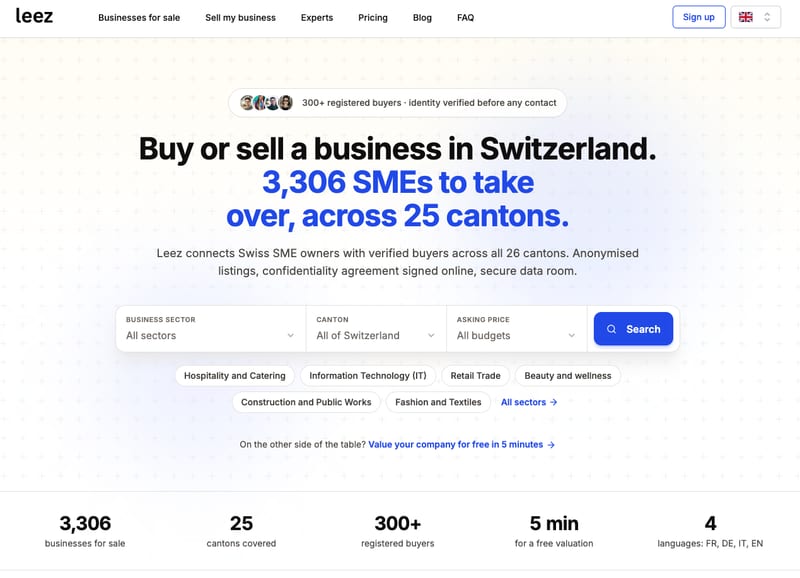
LEEZ (leez.ch) is a Swiss marketplace for business transfers. It connects SME owners who want to sell their company with buyers, and with the experts who support them. It was founded by four Swiss entrepreneurs who had each started, grown and then passed on their own SME, and who had seen how complex the process was, and how little visibility it had.
What it does
| For whom | What LEEZ brings |
|---|---|
| The seller | A free valuation in five minutes, an anonymised listing whose location stops at the canton, a secure data room (a document space with controlled access) |
| The buyer | Listings sorted by canton, sector and budget, after identity verification and online signature of a non-disclosure agreement (NDA) |
| Experts: fiduciaries (Swiss accounting and trust firms), business brokers, lawyers | A directory, and a shared tool for tracking deals |
In early October 2026, the site shows about 3,300 businesses for sale in 25 cantons, more than 300 registered buyers and four languages.
What it wants to become
LEEZ's stated ambition comes down to three points: give more visibility to businesses looking for a successor, bring the whole ecosystem together on a single platform, and offer sellers, buyers and intermediaries a simple, structured and secure tool. The aim is to become the go-to player for business transfers in Switzerland. LEEZ puts figures on the stakes as follows: more than half of Swiss business leaders are over 55, and about 75,000 businesses, or some 400,000 jobs, will have to change hands by 2030. Other estimates exist: Dun & Bradstreet counted 90,667 SMEs in need of a successor in 2025.
My reading, from the growth side: move from a listings site to the infrastructure of business transfers. The one that AI assistants cite, and whose data sets the standard.
Who lists the most businesses for sale: the platform ranking
To put LEEZ in context, I counted the businesses for sale shown on each buying and selling platform. Here are the ten largest listing inventories I found, recorded on the sites on 5 October 2026. I kept only platforms that publish their own listings, not aggregators that republish other people's.
| Rank | Platform | Country | Businesses for sale listed |
|---|---|---|---|
| 1 | CessionPME | France | 62,187 |
| 2 | BusinessesForSale.com | United Kingdom, global reach | 51,906 |
| 3 | BizBuySell | United States | About 42,000 |
| 4 | Place des Commerces | France | 35,456 |
| 5 | BusinessBroker.net | United States | More than 28,000 |
| 6 | RightBiz | United Kingdom | 19,640 |
| 7 | DealStream | United States, global reach | 17,438 |
| 8 | IndiaBizForSale | India | 17,013 |
| 9 | SEEK Business | Australia | 16,392 |
| 10 | CommercialRealEstate.com.au | Australia | 15,279 |
This ranking comes with four caveats.
- A listing is not an SME. The largest inventories are made up of small retail businesses, cafés and restaurants. On CessionPME, the section for companies for sale has 3,361 listings, against 58,826 for retail businesses.
- The same listings circulate from one site to another. A business broker publishes the same mandate on several platforms. These inventories cannot be added together.
- The counters do not measure the same thing. Some include franchises to be set up, commercial premises or searches for investors. Three figures are my own calculations based on the sites' counters: CessionPME, BizBuySell and Place des Commerces.
- The inventory moves by the hour. BusinessesForSale.com showed 51,879, 51,906 and then 51,949 listings on the same day.
Just below the top 10 come Bsale in Australia (13,595 listings) and Daltons Business in the United Kingdom (13,208). In Japan, BATONZ claims more than 10,000 deals online.
Outside the ranking, aggregators show more: Kumo shows 101,453 and Bpifrance's Bourse de la transmission 42,054. Exchanges focused on SMEs are much smaller: 6,387 offers on nexxt-change in Germany, 2,008 on Fusacq in France, 1,189 on Brookz in the Netherlands.
The Swiss ranking
I did the same count in Switzerland on 5 October 2026, on marketplaces and on business brokers that publish their catalogue online.
| Rank | Platform | Type | Businesses for sale listed |
|---|---|---|---|
| 1 | LEEZ | Marketplace | 3,306 |
| 2 | Remicom | Business broker network | About 1,000 |
| 3 | Firm4sale | Marketplace | 390 |
| 4 | Capital First | Business broker | 365 |
| 5 | Nachfolgeportal | Marketplace | 351 |
| 6 | Firmo | Marketplace | 307 |
| 7 | companymarket.ch | Marketplace | 268 |
| 8 | Relève PME | Marketplace in French-speaking Switzerland | More than 160 |
| 9 | Business Broker AG | Business broker | 59 |
| 10 | Nachfolger-Börse | Business broker | About 47 |
Foreign platforms carry little weight in Switzerland: 73 Swiss listings on DealStream, 17 on BusinessesForSale.com.
The caveats of the world ranking apply here too. Three figures were not read straight off a counter: those for Remicom and Nachfolger-Börse are estimates, and the one for Relève PME comes from a presentation.
My reading: LEEZ shows the largest inventory in the country, more than eight times that of the second marketplace. It is a figure nobody else can publish, and therefore a reason to be cited. But an inventory does not say what sells: no Swiss marketplace publishes a figure for completed transfers. The first to do so will hold the figure that the press and AI assistants will repeat.
Why a marketplace is the most demanding case
| Difficulty | What it means | At LEEZ |
|---|---|---|
| Two audiences to convince at the same time | No listings, no buyers; no buyers, no listings | About 3,300 listings for just over 300 buyers: the hard side is qualified demand |
| Diverging interests | The seller wants a good price, discretion and little disruption. The buyer wants a low price, information and speed | Anonymity and the NDA act as referee |
| A third audience | Intermediaries can be partners or competitors | Fiduciaries and business brokers bring in deals, or keep them |
| Disintermediation | Once introduced, the two sides no longer need the platform | The sale is completed at the notary's or the fiduciary's office, outside LEEZ |
| Traffic diversion | Aggregators, search engines, AI assistants and competitors pick up the listings and answer in your place | LEEZ's listings can be republished elsewhere |
| A one-off purchase, a long cycle | You sell your business once, and it takes months, often more than a year | Repeat business does not come from the customer, it comes from partners |
| Trust | Fake buyers, empty listings, identities that leak | Identity verification and listing quality are the product |
How to read what follows
From here on, the levers are applied to LEEZ in two steps. First, what the lever brings to the goal: how it helps an owner pass on a business, or a buyer find one. Then what that looks like in practice.
I did not choose this case for convenience. A tactic that works on a marketplace, with two audiences whose interests are opposed and who must come to agree on every point, will work on a simpler model. The reverse is not true.
First lever, and the most powerful: the one that carried the three hacks in section 2. It remains to be seen whether it works in a trade where nobody shares anything.
Section 8
Product-led growth
Quick take
The best acquisition channel is a product that spreads as people use it: that is what drove the three hacks in section 2. In a confidential trade, where nothing is shared in public, the loop runs through the people the process forces you to bring in: the counterparty, the advisers, the experts. That is LEEZ's bet.
What the three hacks have in common
| Case | What the user does | What their use produces | Who it attracts |
|---|---|---|---|
| ChatGPT and the “Ghibli” wave | They transform their photo | A recognisable image, which they post | Their contacts, who want one of their own |
| Lovable and Cursor | They describe an app and get it within minutes | A public app or website | Other builders, by word of mouth |
| OpenClaw | They install an agent and show it in action | Demos and a public spectacle | Developers, then the press |
In each of these three cases, using the product already means spreading it.
What “product-led growth” means
The term product-led growth was coined in 2016 by Blake Bartlett, of the fund OpenView. In this model, the product itself does the work of acquisition, activation and retention. Conventional growth hands that work to advertising or a sales force.
Three conditions keep coming up in the cases that work.
- Immediate value. The user gets a first result within minutes, without talking to anyone.
- One use that leads to another. Each use exposes the product to someone new: an image shared, an invitation sent, or a person who has to come onto the platform to respond.
- A clear journey. The user knows where they stand, what comes next and what it costs.
The limits
- Retention remains the judge. A product that spreads fast can empty just as fast: Lovable's traffic showed as much (section 2).
- Trust is lost in a few days. OpenClaw grew faster than its security, and companies turned away from it.
- Not everything can be shared. An owner will never post on social media that they are selling their business. In a confidential trade, the loop does not run through public sharing. It runs through the people the process forces you to bring in: the counterparty, the advisers, the experts.
My advice
Before investing in a channel, I ask the product three questions. What does the user get in their first five minutes? Who else has to come onto the product for them to move forward? Does the user know where they stand, what comes next and what it costs?
Applied to LEEZ
What it brings. Transferring a business is expensive, partly because the market is opaque. The seller knows neither which steps lie ahead, nor which expert they need, nor what that expert should cost. Neither does the buyer. A tool that makes the path clear and puts experts in competition saves sellers and buyers substantial costs, and lets more transfers go all the way through.
The orders of magnitude. For a sale of 15 million Swiss francs, expect about 300,000 francs in transfer costs, or 2% of the price. For the smallest transfers, it is generally 10% of the final sale price, with a minimum of 15,000 francs, commission and expenses included. In proportion, the small business therefore pays five times more than the large one.
These amounts vary widely with the sector, the complexity of the due diligence (the in-depth audit of the business before the purchase), the number of employees and the preparation done beforehand by the seller and the buyer. Handing your business over to an employee or to your managers lightens both the bill and the support needed, because much of the knowledge is already in the successors' hands.
What opacity costs. LEEZ's 2026 reference guide to acquisition financing reviewed 141 accounts from sellers, buyers, banks, business brokers and tax advisers. Four findings emerge.
- Prices are not published. None of the named profiles of banks, guarantors and business brokers consulted shows a price. The firm Auditrium is one of the few to put a figure on an adviser's success fee: often 2 to 5% of the price for a mid-sized business.
- Timelines are long. Selling to a third party takes five to nineteen months in the cases reviewed. A family succession lasts more than six years on average, according to Zürcher Kantonalbank.
- Mistakes are costly. In a case published by VZ, a seller who started too late could no longer buy in pension fund years and missed out on nearly 100,000 francs in tax savings. In a case decided by the Federal Supreme Court (judgment 4A_220/2013), a warranty given on the order book cost the seller 1.39 million francs.
- Neither side knows what the other would accept. Two thirds of sellers would be willing to finance part of the price, but only one buyer in eight considers asking for it, according to the KMU Spiegel 2015 study by the St. Gallen University of Applied Sciences.
Why it works on a marketplace. Product-led growth needs volume, and a marketplace has it: about 3,300 businesses listed, more than 300 registered buyers. Volume brings the introductions. What matters next is the experience once the seller and the buyer have been put in touch. That is what creates the “wow” effect, keeps both parties on board and prevents disintermediation.
What is already automated. Part of the journey already happens without paper or appointments. That is useful from the very first step: according to the Observatoire BCV des entreprises 2025, one in two Vaud businesses due to be transferred has not yet been valued.
| Step | By hand | On LEEZ today |
|---|---|---|
| Value the business | A meeting and a valuation mandate | A valuation range in five minutes, with a valuation report |
| Publish without revealing yourself | A listing written and circulated by an intermediary | An anonymised listing, located at canton level |
| Screen out the merely curious | Calls and case-by-case checks | Each buyer's identity is verified before any contact |
| Sign the non-disclosure agreement (NDA) | A document sent, printed, signed, scanned and returned | The agreement is signed online, before access to the full file |
| Share documents | Attachments sent by email | A secure data room |
| Follow the market | Repeated searches across several sites | Alerts by criteria, on listings updated every hour |
The non-disclosure agreement shows what automation changes. In a conventional sale, it is the first speed bump: each interested buyer receives a document, signs it by hand and sends it back, and the seller or their business broker keeps the list of who signed what. On LEEZ, the verified buyer signs online. Each access to the file is thus tied to a verified identity and a signed agreement. Confidentiality becomes a step in the product, and no longer a formality between two emails.
Four languages. LEEZ works in French, German, Italian and English. This lets it cover the whole of Switzerland, bring together a seller from French-speaking Switzerland and a buyer from German-speaking Switzerland, and attract foreign capital for larger acquisitions.
In practice. LEEZ's ambition is to build the best digital business transfer tool in Switzerland. Two building blocks are in development.
- A personalised journey, visible to both sides. The experience adapts to the size of the business, its legal form and its situation. The legal form really does change the path: the second pillar (occupational pension), for example, can finance the takeover of a sole proprietorship, but not the direct purchase of shares in a limited company (SA). The full journey is visible to the seller and the buyer alike. Each knows what they have to do, what the other has to do and when. That brings clarity and certainty, at a time when nobody wants to get it wrong.
- A call for tenders tool, at every step. Some steps require specific expertise, due diligence for example. The entrepreneur posts what they need, the experts connected to the platform respond, and the entrepreneur chooses among several offers. The call for tenders is anonymous: the identity of the seller or buyer is revealed only when they accept an offer, to preserve maximum discretion.
Supported or solo. Each party chooses. The seller, like the buyer, can be supported by a professional from start to finish, or run the transfer themselves and launch a call for tenders only at the steps where they need an expert.
Under 500,000 francs: the same care. An SME worth 15 million can afford to surround itself with help: a business broker, a lawyer, a tax adviser, and access to selected buyers. A business worth less than 500,000 francs cannot, and it is the one that pays the most in proportion. Yet it is the heart of the market: about three quarters of the listings on LEEZ ask for less than 250,000 francs (section 16). LEEZ wants to develop a product for these small businesses that gives them a quality of service and access to buyers close to what an SME worth 15 million gets.
The loop. Each deal brings its counterparty and its advisers onto the platform. Each call for tenders gives experts a reason to come back, and to bring their own clients with them. The more experts there are, the wider the choice and the clearer the prices, which attracts new sellers and new buyers.
This loop answers two difficulties described in section 7. Disintermediation: the deal stays on LEEZ because its steps take place there. Repeat business: it comes from the experts, who return for every deal.
A clear journey is still not enough to close a deal, though. Between the committed buyer and the signature, one obstacle remains that no listing solves: money. To remove it, you have to get inside the trade.
Section 9
Financing an acquisition: understanding the needs
Quick take
You only find a growth lever in a trade you understand in detail. I look for the place where the customer journey really gets stuck. In business transfers, it is not the listing that is missing, it is the financing: banks ask for at least 30% equity, and many buyers do not have it. LEEZ wants to remove this bottleneck, because a buyer who knows how to finance one acquisition can finance a second.
Why financing is the sticking point
Banks ask for at least 30% equity, part of which must not come from pension savings. Many buyers do not have it. According to a Basler Kantonalbank study published in 2025, 37% of SMEs in north-western Switzerland have not yet resolved the financing of their succession. No single instrument is enough: an acquisition is always financed by a combination.
The benchmarks in this section come from LEEZ's 2026 reference guide to acquisition financing, which describes 22 methods. I have kept seven. They are orders of magnitude, and no substitute for tax advice. EBITDA, which comes up often, is earnings before interest, taxes, depreciation and amortisation.
Seven ways to raise the funds
| Method | What it brings | Order of magnitude | Point to watch |
|---|---|---|---|
| Buyer's equity | The base the bank requires | At least 30% of the price | Personal assets are on the line |
| Bank acquisition loan | The largest share of the financing | 2 to 3 times EBITDA, for acquisitions of 0.5 to 20 million Swiss francs | The covenants agreed with the bank and rising interest rates |
| Loan guarantee | A guarantee that sways the bank when collateral is lacking | Up to 1 million francs per business; an assessment fee of about 1%, then 1.25% a year | Reserved for viable SMEs |
| Vendor loan | The seller agrees to be paid partly later | 10 to 30% of the price | The seller's claim ranks behind the bank's |
| Earn-out | Part of the price depends on future results | Deals of 1 to 20 million, mainly in services | Reclassified as salary if it remunerates the seller rather than the business |
| Buyer's second pillar (occupational pension) | Their pension savings serve as an equity contribution | Small acquisitions, up to about 2 million | Only possible for taking over a sole proprietorship, with a five-year lock-in |
| Investors | Outside equity: private equity, search funds, family offices | 20 to 50% equity; search funds for an EBITDA of 2 to 7 million | Governance and exit |
How a deal structure is put together
Why go into this much detail in a growth guide? Because you only find a weak point in a system you understand. A growth hacker who knows the sector, the field and the trade in depth sees where the journey really gets stuck, and that is where they act. Without meta-vision, that is, without an overall view of the system, no hack is possible: all that remains is tactics applied at random.
In the vast majority of Swiss SME acquisitions, the standard structure is the same. The seller sells shares held as private assets, which in principle makes the capital gain tax-exempt. The buyer purchases them through an acquisition holding company, financed by about 30% equity, 50 to 70% bank debt and 10 to 30% vendor loan or earn-out. This exemption rests on one condition: for five years, the debt must not be repaid with the reserves not needed for operations that existed at the time of the sale.
The proportions change with the size of the deal.
| Size | Vehicle | Indicative mix |
|---|---|---|
| Under 1 million | Sole proprietorship or small holding company | Equity 15%, second pillar 15%, guaranteed bank loan 50%, vendor loan 20% |
| 1 to 5 million | Acquisition holding company | Equity 30%, bank 50%, vendor loan 15%, earn-out 5% |
| 5 to 20 million | Management buyout with an investor | Managers 10%, investor 25%, bank 45%, vendor loan 10%, earn-out 10% |
| Over 20 million | Private equity | Private equity 40%, senior debt 40%, mezzanine 10%, seller rollover 10% |
An example in figures: an SME valued at 3 million francs, or five times its EBITDA of 600,000 francs. The buyer puts in 900,000 francs, the bank lends 1.8 million and the seller grants a loan of 300,000 francs. The bank debt is repaid over six years, at 300,000 francs a year.
The canton changes the bill
The canton does not rule out any method, but it changes what each one costs. In the example above, corporate profit tax falls from 102,700 francs a year if the business is in Bern to 58,300 francs if it is in Lucerne. Over six years, the gap comes to about 266,000 francs, or nearly 15% of the bank debt.
| What varies | Canton that counts | Gap recorded in 2026 |
|---|---|---|
| Profit tax on the acquired business | Registered office of the business | 11.66% in Lucerne, 20.54% in Bern |
| Dividend paid to the seller before the sale | Seller's place of residence | Taxable at 50% or up to 80% depending on the canton |
| Withdrawal of 500,000 francs from the second pillar | Buyer's place of residence | 25,703 francs of tax in Appenzell Innerrhoden, 49,545 in Appenzell Ausserrhoden |
| Transfer to a child | Seller's place of residence | Taxed in the cantons of Vaud, Neuchâtel, Appenzell Innerrhoden, Lucerne and Solothurn; exempt in most others |
| Property transfer tax | Location of the property | From 0 to 33‰ |
The seller's retirement is part of the structure
The sale price is often the seller's retirement capital. A good structure therefore also looks at what the seller has left after tax, and that needs preparing up to ten years in advance.
- Sell shares rather than a sole proprietorship. The gain on privately held shares is in principle tax-exempt. The conversion into a limited company (SA) must take place at least five years before the sale.
- Buy in pension fund years. These buy-ins are deductible from income, provided the capital is not withdrawn within the following three years.
- Take out what is not needed for operations. Separating out the property and the surplus cash reduces the price the buyer has to finance.
- Distribute profits regularly rather than hoarding them.
The right structure reconciles two needs: what the buyer can repay, and what the seller needs for retirement.
In the field: what I heard at the Foire du Valais
A good growth hacker scours their sector and observes it. They bring back accounts and lessons, then turn them into answers to needs, in the form of a product. On 2 October 2026, I attended the Rendez-vous de la transmission d'entreprise at the Foire du Valais. Here are my notes, and what I draw from them.
| What I heard | What I take from it | The answer to build into the product |
|---|---|---|
| In a management buyout, the seller is wary of private equity funds. They put the fund and their own management in competition, and want to be reassured about the team. | The seller chooses a buyer as much as a price. | Present several types of buyer side by side: managers, third parties, investors. |
| The meeting with the buyer is like a job interview. You have to analyse the business and tell each other everything. | Trust is built in stages, and transparency is the condition for it. | A journey visible to both sides, where each step says what each party must show (section 8). |
| Around the table: a financial adviser, a legal adviser, and a communications agency to announce the sale. | A transfer draws on several professions, including communications, which is often forgotten. | A call for tenders at every step, communications included. |
| There is a lot of emotion on the seller's side. And one question keeps coming back: what to do after the transfer? | The sale is also a personal matter. | A journey that does not stop at the signature. |
| According to Bastien Emery, of Banque Cantonale du Valais, half of the roughly 100,000 SMEs due to be transferred have prepared nothing, and 42% are passed on to the children. | The need begins well before the business is put up for sale. | A free valuation and a journey open from the very first thoughts. |
| Also according to him: start with the owner's retirement needs, and finance the retirement rather than dealing with the transfer alone. | The structure starts from the seller, not from the business. | Build the seller's retirement into the structure, as described above. |
| The tools mentioned: acquisition loan, working capital loan, leasing, acquisition holding company. | The buyer has to finance the purchase, but also the operations. | A structure that covers both needs. |
| If the owner's salary was not in line with the market, the social security compensation office can go back over past years in which dividends were paid. | Some risks are hidden in the business's past. | A list of points to check before the sale. |
| David Martinetti: nobody has every string to their bow. You have to surround yourself with others, look for another point of view and listen to what has been done elsewhere. | Nobody transfers a business alone, and other people's mistakes are instructive. | Give access to experts and to lessons from experience. |
It is this kind of listening that feeds a good product, like the ones described in this section and the previous one.
Applied to LEEZ
What it brings. A buyer who has pulled off one deal structure can pull off others. They become a multipreneur: an entrepreneur who has bought several businesses. Each financed acquisition paves the way for another, and each seller gains one more buyer.
In practice. The transfer journey (section 8) is meant to bring these parameters together in one place: the size of the business, its legal form, the cantons involved, the buyer's funds and the seller's retirement needs. The aim is to optimise the whole, not each element separately.
An AI of LEEZ's own. An artificial intelligence trained on the transfers completed on LEEZ will refine the experience as deals close. Each transfer improves the recommendations, which brings more transfers.
None of this happens without volume. That is why the rest of this guide focuses on growth and customer acquisition. And in 2026, all customer acquisition starts with the same question: what has AI really changed?
Section 10
Growth hacking in the age of AI: the full picture
Quick take
In 2026, AI has made execution almost free: a prototype is built in a day, dozens of variants in an hour. What becomes scarce, and therefore valuable, is distribution and trust.
What AI changes, step by step
Acquisition. Search is becoming conversational: AI Overviews and assistants answer without sending a click (see section 15). Generic content mass-produced by AI loses value; original data, expert opinions and brand mentions gain it. Browsing and shopping agents become a new “segment” to serve.
Activation. Onboarding can be personalised in real time by a built-in assistant; “time-to-value” gets shorter. Lovable and Cursor (section 2) deliver their first result within minutes.
Retention. AI makes it possible to detect churn (customers leaving) earlier and to automate relevant follow-ups; but AI summaries in inboxes reduce the visibility of emails (section 21).
Testing. You can generate dozens of page or ad variants in an hour. The bottleneck becomes the traffic available to reach statistical significance, and the judgement to choose what to test.
Cost of experimentation. A prototype that used to take two weeks of development can be built in a day with Cursor, Claude Code or Lovable. The consequence: speed is no longer a lasting competitive advantage; distribution and trust are.
The go-to tools in 2026
- Building: Cursor, Claude Code, Lovable, v0, Replit.
- Automation: n8n, Make, Zapier, and agents able to call MCP servers.
- Research and content: ChatGPT, Claude, Gemini, Perplexity, with Agent Skills to standardise procedures.
- Measuring AI visibility: a new category of tools that track citations in generative engines (section 15).
The limits (to be taken seriously)
- Saturation: when everyone can produce, average content becomes noise.
- Trust: consumer preference for AI-generated creator content fell from 60% in 2023 to 26% in 2025 (section 30).
- Regulation: since 2 August 2026, Article 50 of the AI Act has required chatbots and synthetic content likely to mislead to be disclosed (section 30).
- Hidden costs: model calls, agent errors and security (the OpenClaw case) come at a price.
- Platforms: Google, Meta and the marketplaces keep adjusting their rules against low-quality content and abusive automation.
My verdict: AI is a multiplier, not a strategy. It multiplies good positioning and bad positioning alike.
Applied to LEEZ
What it brings. An owner thinking of selling first wants a number, without exposing themselves or paying an expert. By making the valuation immediate, AI turns the first step into a five-minute matter. That is often what separates a prepared retirement from a forced closure.
In practice.
- The free valuation is the moment when the seller receives something useful. That is what AI should speed up and explain, not the mass production of listings.
- Listings are translated into four languages, with human review. An SME in French-speaking Switzerland can thus find its buyer in Zurich or Ticino.
- An AI already answers “how much is my business worth?” without going through LEEZ. Its answer needs to rest on a reliable source (section 16).
If AI writes, tests and answers in the website's place, what is a website still for? One thing only, and the 2026 numbers point to it.
Section 11
How people still reach a website in 2026
Quick take
People ask me whether anyone still visits websites. Yes, but they arrive there last, to act, after putting their question to Google or an AI. A website is no longer there to be found, it is there to close.

Mobile or desktop
| Region | Mobile | Desktop | Tablet |
|---|---|---|---|
| World | 58.99% | 39.26% | 1.76% |
| Switzerland | 46.59% | 51.71% | 1.70% |
Share of page views in September 2026, according to StatCounter.
Three takeaways:
- Switzerland remains a desktop country. It is one of the markets where the desktop screen still leads the phone, and the gap widens in B2B, where decisions are made at work.
- Mobile is mostly apps. Most of the time spent on a phone happens in apps, not in the browser. A mobile site is viewed between two apps, quickly, often from a link someone sent.
- Mobile discovers, desktop closes. Industry benchmarks give a conversion rate two to three times higher on desktop. That is an order of magnitude, to be measured in your own analytics.
Where visits come from
| Entry point | What the numbers say | What it changes |
|---|---|---|
| Google Search | 68% of US searches end without a single click (SparkToro and Similarweb, January to April 2026). Out of 1,000 searches, 276 clicks go to the open web, compared with 374 in 2024 | Google remains the leading source of visits, but each ranking position brings in less |
| AI answers in Google | AI Overviews appear on more than 20% of searches. AI Mode captures only 0.34% of searches, but Google credits it with more than a billion monthly users | The answer is read without a visit: you have to be cited in it |
| AI assistants | ChatGPT accounted for 0.32% of websites' referral traffic in May 2026, compared with 0.23% in April (SE Ranking). Conductor measures 1.08% among large companies, most of it from ChatGPT | Small in volume, rising fast, and better qualified: according to Adobe, these visitors converted 54% better than the others in US retail in May 2026 |
| Direct visits | Some of the visits that come from an AI arrive without a referrer and are filed under direct traffic | The brand people type from memory becomes a front-rank channel again |
| Bots | 57.5% of web page requests came from bots in June 2026, according to Cloudflare. The measurement covers HTML pages, not the whole internet | Your analytics count machines, and AI systems read far more pages than they send visitors |
One detail matters for website design: according to SE Ranking, 60% of visits sent by an AI land on the home page, compared with 17% for conventional search. The home page is becoming a landing page again.
In Switzerland
IGEM's Digimonitor 2026, based on 1,957 people surveyed in the spring, gives the local picture.
- 80% of the population uses AI, compared with 40% in 2024.
- 77% use the AI mode of conventional search engines.
- 57% search directly in an AI platform, more than on YouTube (34%) or social media (28%).
- ChatGPT reaches 67% of the population, or 4.3 million people, including 17% every day. Gemini follows at 32%, Copilot at 30%.
What I conclude
- The website is no longer the first page read, it is the last. People come to it to act. Action pages (valuation, quote, alert, contact) deserve more care than the blog.
- You have to win twice. Once in the answer from Google or the AI, to be named. A second time on the website, to convert the person who remembered the name.
- Measurement changes. Organic sessions fall even when brand awareness rises. I track brand searches, direct traffic and AI citations, and I filter out bots.
Applied to LEEZ
What it brings. The buyer is often an employee searching in the evening, on their phone. The seller, meanwhile, prepares a substantial file at their desk. If each finds the platform on the screen they use, no possible match is lost for a technical reason.
In practice. This is a hypothesis to test: alerts and listing pages designed for mobile, a valuation and a listing submission designed for desktop. And since 4.3 million people use ChatGPT in Switzerland, the question “how do I sell my business?” is now put to an AI before it is put to Google. Being the cited answer there is the subject of section 16.
The 2026 visitor therefore arrives late, and already informed. What remains is to know what to show them, and at what moment.
Section 12
Credibility of a digital platform: what to show, to whom and when
Quick take
Trust cannot be decreed on the home page. In 2026, the visitor has already read what Google or an AI says about me: so I spread the proof along the journey. The right proof, at the moment doubt appears, verifiable in one click.
Why it has become decisive
- The visitor arrives to verify. They have already done their research with Google or an AI (section 11). The website must confirm, not seduce.
- What the brand says about itself carries little weight. Edelman's 2026 Trust Barometer concludes that the word of unpaid third parties counts far more than the brand's.
- The absence of third-party proof arouses suspicion. In a 2026 TrustedSite survey, 40% of shoppers say they distrust an unknown website that displays no trust indicator verified by a third party. TrustedSite sells these badges: I take the gist, not the figure.
- Machines reason the same way. AI assistants mostly cite sources the brand neither owns nor pays for (section 29).
What to show, and when
| Moment | The visitor's doubt | The proof to show | To avoid |
|---|---|---|---|
| The first second, on the landing page | Is this reputable, is it for me? | A clear sentence, dated figures, three to five logos of institutional partners known locally, each linked to the partner's page that mentions you | The wall of forty logos, the logo used without permission |
| Discovery, on the offer pages | Does it work for people like me? | Dated, attributed case studies, testimonials with name, role and company, reviews hosted on a third-party platform | Anonymous testimonials, stars with no source |
| Before handing over their data | What happens to my information? | Next to the button: who will see what, where it is hosted, a link to the privacy policy | Decorative badges that anyone can paste on |
| Before committing | Can I entrust them with serious business? | A security page: audit attestation to download, certifications, subprocessors, registered company name, address, team | The full audit report freely accessible |
| After the action | Did I do the right thing? | A summary, a named contact, the next step | Silence |
Institutional partner logos
- Written permission for each logo.
- The exact word: “partner”, “member” and “supported by” do not mean the same thing, and the Unfair Competition Act (UCA) penalises misleading statements.
- Mirrored proof: the logo links to the page where the institution mentions you. Without it, the logo proves nothing.
- Local first: for an SME in French-speaking Switzerland, a cantonal chamber of commerce reassures more than an American media outlet.
The downloadable security audit: yes, at two levels
- Freely accessible: an attestation or a summary of the penetration test (date, scope, provider, overall conclusion), the certifications obtained, the list of subprocessors, an address for reporting a vulnerability.
- On request, under a non-disclosure agreement (NDA): the full report. Published as it stands, it serves as a map for an attacker.
- Dated and renewed: a 2023 audit displayed in 2026 does you a disservice.
- Nothing you do not have: no label, and no certification in progress presented as obtained.
In Switzerland, hosting in the country and labels such as swiss made software or the Swiss Digital Trust Label speak to local customers.
The white paper and the roadmap, web3 style, for a web2 solution
Web3 projects publish a white paper, a quarter-by-quarter roadmap and code audits because they ask strangers for money without having a track record. The document makes up for the lack of a past. The method has also produced its excesses: roadmaps never delivered and white papers that were nothing but brochures.
| Web3 practice | What to keep in web2 | What to leave behind |
|---|---|---|
| The white paper | A methodology document: how the platform works, how it calculates, how it protects data, who pays whom | The jargon, the promises of returns, the brochure in disguise |
| The public roadmap | Three columns without dates (now, next, later) and above all a log of what has been delivered | Firm dates, which become broken commitments |
| Published audits | The security attestation described above | — |
| Governance by the community | A board where users vote for the next features | The token |
My view: for a platform that handles serious business, the methodology white paper is relevant, because it serves three readers at once: the customer who verifies, the journalist looking for a source, and the AI looking for a text to cite. The delivery log is worth more than the roadmap: it proves you are moving forward, where the roadmap only promises. A public roadmap also informs competitors, and every delay shows.
Applied to LEEZ
What it brings. Selling a business that is a life's work requires total trust. At the slightest doubt, the owner gives up, postpones, and sometimes ends up closing. Each piece of proof placed at the right moment removes one reason to give up.
In practice.
- On the home page: a dated listing counter, and the logos of professional associations as partnerships are signed.
- Before the valuation: a sentence on anonymity, saying what a buyer will and will not see.
- Before submitting a listing: a security page, with the audit attestation, the subprocessors and the company's identity.
- A white paper, “How LEEZ values a business”, so that anyone can verify the method.
- A reference guide, modelled on the 2026 edition of LEEZ's guide to acquisition financing: it cites its legal bases in full, links each of its 141 accounts to its source and devotes a chapter to its own limits.
All this proof is addressed to a human reader. But the next visitor may not read the page: it will scan it in a fraction of a second, because it is a program.
Section 13
What an AI agent is and how to build websites that speak its language
Quick take
More than one in two web page requests now comes from a bot. An agent does not look at a page, it reads it: clean HTML, structured data, declared actions. So I build pages a machine understands without having to guess.

What is an AI agent?
An AI agent is a system built on a language model that receives a goal, plans steps, uses tools (browser, APIs, files, payments) and acts semi-autonomously until it reaches the result or asks for approval. The difference from a chatbot: the chatbot answers, the agent acts.
In 2026, three families of agents visit your website:
- Generative engine crawlers (for training or real-time search).
- Browsing agents built into browsers and assistants, which read and click on a user's behalf.
- Transactional agents that compare, fill a cart and pay via dedicated protocols.
How an agent “reads” a website
An agent prefers explicit structures to visual interfaces. It reads the HTML, the structured data, the accessibility attributes and, increasingly, dedicated entry points (APIs, MCP servers, tools declared via WebMCP). A website that relies on heavy JavaScript, unlabelled buttons or content held in images is partly unreadable to an agent.
The building blocks for speaking the agents' language
| Building block | What it is for | Maturity level in 2026 |
|---|---|---|
| Semantic HTML and accessibility (ARIA, labels) | Lets agents understand the roles of elements | Fundamental, mature |
| schema.org structured data (JSON-LD) | Describes entities, products, prices, authors, FAQs | Mature, essential for SEO and GEO |
| robots.txt and AI crawler management | Allow search crawlers, decide about training crawlers | Mature, now strategic |
| llms.txt | A Markdown file listing the key pages for LLMs | Community proposal; real adoption by the major engines not demonstrated, useful but not magic |
| Markdown pages / text versions | Make content readable without JavaScript rendering | Emerging good practice |
| Documented public APIs | Let agents act reliably | Mature |
| MCP server | Expose your product's functions to assistants | Being adopted fast (section 14) |
| WebMCP | Declare tools directly in the page for the browser's agent | W3C Community Group project backed by Google and Microsoft; being trialled in Chrome (section 14) |
| NLWeb | Microsoft's proposal for making a website queryable in natural language | Experimental, worth watching |
| A2A (Agent2Agent) | Communication between agents, with “Agent Cards” | Adopted in enterprise ecosystems |
| Agentic commerce protocols: ACP, UCP, AP2 | Let agents buy | Under construction, active competition |
Agentic commerce in 2026
Three protocols are competing for agent purchasing: ACP (OpenAI and Stripe), UCP (Google and Shopify) and AP2 (Google, for payment mandates delegated to agents). Section 14 covers the first two in detail. Standardisation is not finished: betting on a single protocol remains risky.
Good practice in concrete terms
- Audit your website with a browser that has JavaScript turned off: what you see is roughly what an agent in a hurry sees.
- Add complete structured data (Organization, Person, Product, Article, FAQPage, BreadcrumbList).
- Write a clear policy in robots.txt: allow search crawlers (for example OAI-SearchBot, PerplexityBot, Googlebot), and make a conscious decision about training crawlers (GPTBot, ClaudeBot, Google-Extended).
- Publish a minimal API or MCP server for the key actions (search, book, request a quote).
- If you do e-commerce, follow UCP and ACP through your platform (Shopify, Stripe) rather than building them yourself.
My view on real adoption: in French-speaking Switzerland, the vast majority of SME websites are not even up to date on schema.org. So that is where the lead is to be gained, well before WebMCP or purchasing protocols.
Applied to LEEZ
What it brings. Tomorrow, a young buyer will ask their assistant: “find me a joinery business to take over in the canton of Fribourg”. If the agent cannot read LEEZ's listings, the joinery stays invisible, and it will close for want of being seen.
In practice.
- Each listing can be read without JavaScript, with its structured data: canton, sector, price range, date of last update.
- The robots.txt file is a business decision. The door is open to AI search crawlers, which cite and send visitors back. It is closed to training crawlers, which hoover up listings and give nothing in return: this is the traffic diversion described in section 7.
- An agent can search for a listing and prepare a request for a non-disclosure agreement (NDA). The signature stays human, because that is what protects the seller.
Reading a website is only the first step. Four protocols now let agents act, each through a different door, and not all of them lead to you.
Section 14
MCP, skills, plugins, APIs: what is changing?
Quick take
MCP, WebMCP, ACP and UCP are not four versions of the same thing: they are four different doors. MCP plugs a product into AI assistants, WebMCP makes a page usable by the browser's agent, and ACP and UCP bring a catalogue into agentic commerce. I never open all four at once: I pick the one my customers come through.
Four protocols, four doors
Each row reads from left to right: the agent is somewhere, the protocol tells it how to talk to you, and you expose only what you choose.
| Protocol | The question it answers | Who backs it | Status in October 2026 |
|---|---|---|---|
| MCP (Model Context Protocol) | How does an assistant use my product and my data? | Anthropic originally, now the Agentic AI Foundation (Linux Foundation) | Open standard, specification 2026-07-28, supported by Claude, ChatGPT, Gemini, Copilot, Cursor and VS Code |
| WebMCP | How does the browser's agent use my page without guessing where to click? | Proposed web standard, implemented by Chrome | Origin trial from Chrome 149, subject to change |
| ACP (Agentic Commerce Protocol) | How does my catalogue show up in ChatGPT? | OpenAI and Stripe | Beta, Apache 2.0 licence, refocused on product discovery in March 2026 |
| UCP (Universal Commerce Protocol) | How does an agent buy from me, from search to after-sales? | Google and Shopify originally, a technical council of ten companies | Open standard, checkout live mainly in the United States, being extended to hotels and restaurants |
MCP: plugging your product into AI assistants
What it is. Released by Anthropic in November 2024, the Model Context Protocol is an open standard that describes your tools and your data so that any assistant can use them. It is often compared to a USB-C port for AI: one connection, every assistant.
How it works. Three roles:
- The host: the AI application (Claude, ChatGPT, Cursor, VS Code…).
- The client: the connector the host creates for each server.
- The server: your program, which exposes tools (actions), resources (data) and prompts (instruction templates). It runs locally or remotely.
Where it stands.
- Adoption. In December 2025, the official blog counted more than 97 million monthly SDK downloads and 10,000 active servers. In July 2026, the main SDKs are approaching half a billion downloads a month, and the TypeScript and Python SDKs have each passed one billion cumulative downloads.
- Specification 2026-07-28. The protocol becomes stateless: each request stands on its own, with no session to maintain. A remote MCP server can now be hosted like any web API, behind an ordinary load balancer. For a small software vendor, the cost of entry drops sharply.
- Official extensions. MCP Apps (interactive interfaces displayed in the conversation), Tasks (long-running tasks) and enterprise-managed authorisation.
- Governance. On 9 December 2025, Anthropic donated MCP to the Agentic AI Foundation, a Linux Foundation fund co-founded with Block and OpenAI and backed by Google, Microsoft, AWS, Cloudflare and Bloomberg. An official server registry has existed since September 2025.
How to use it.
- Get into the connector directories. They are the new app stores. Being there when a user asks “book me a table” or “create a visual” is worth what the top spot on Google was worth in 2010. Canva, Figma, Notion, Stripe, Zapier and Atlassian got in early.
- Start with three high-value tools (search, create, check a status), with OAuth authentication. Write each tool's description as you would write copy: it is what the model reads to decide whether to call you.
- Show, don't just answer. With MCP Apps, your configurator, your simulator or your quote appears in the conversation, where the decision is made.
- Read the call logs like market research. Which tools are called, with which parameters, which ones are missing: it is a direct measure of intent. Honeycomb reports that nearly 20% of its monthly interactive queries already come from agents.
- Automate your own growth stack. An agent connected to your MCP servers (CRM, analytics, email, Search Console) produces the weekly report, spots an anomaly and proposes an experiment. Section 15 gives a full example applied to GEO.
WebMCP: making your pages actionable by the browser's agent
What it is. A proposed web standard. The site itself declares its “tools” (search, book, request a quote), and the agent built into the browser calls them directly instead of simulating clicks and guessing what each button does. According to Chrome's documentation, this is more reliable than conventional browser control, where every step is left to the agent's interpretation.
How it works. Two APIs:
- Declarative: you add attributes to an existing HTML form.
toolnameandtooldescriptionon the form,toolparamdescriptionon a field to spell out what it means,toolautosubmitto allow automatic submission. Without that last one, the user clicks Submit themselves. - Imperative: in JavaScript, you register a tool with a name, a description, an input schema and a function to run.
The tool runs in the page, in full view of the user. Your interface and your brand stay intact.
The difference from MCP. MCP runs on a server: an assistant uses you without ever visiting your site. WebMCP lives in the page: the agent has to be there already. So there is no directory of WebMCP tools, and being found remains a job for SEO and GEO (section 15).
Where it stands. Early preview in Chrome 146 in February 2026, then an origin trial from Chrome 149. For now the only implementation is Chrome's, and Google warns that the API may still change. Angular offers experimental support, and OpenAI's developer documentation includes a “Site tools (WebMCP)” page for Codex.
How to use it.
- First annotate the forms that bring in your revenue: quote, booking, sign-up, valuation. Two attributes are enough, and it is progressive enhancement: nothing changes for humans or for other browsers.
- Write the description like an ad. It tells the agent when to use the tool and what it will get.
- Measure agent-driven conversions. The form's submit event carries an
agentInvokedflag: you can create an “agent” segment in your analytics and compare its conversion rate with that of humans. - Cut the invisible failures. An agent that trips over a date picker or a five-step flow gives up without leaving a trace. A dedicated tool solves the problem.
- Keep human confirmation for sensitive actions. No automatic submission on a payment or a signature.
Limits. It is a trial, designed for a local browser with a human present, not for headless bots. And in an iframe from another domain, tools are disabled by default unless the host site adds allow="tools": that matters for embeds (section 17).
ACP: getting your catalogue into ChatGPT
What it is. The Agentic Commerce Protocol is an open standard (Apache 2.0 licence, still in beta) maintained by OpenAI and Stripe. It was announced on 29 September 2025 together with Instant Checkout, buying inside ChatGPT, initially from US Etsy sellers.
What changed in 2026. In March 2026, OpenAI changed course. According to a spokesperson quoted by Digital Commerce 360, the priority is now product search and discovery, ACP serves as the infrastructure between users and merchants, and Instant Checkout moves into ChatGPT apps. OpenAI now describes ACP as the layer that lets ChatGPT ingest a structured catalogue, understand stock and surface the right products in the conversation. Version 2026-04-17 of the specification covers the cart, the feed, orders, authentication and integration with MCP.
So in six months, ACP went from being the engine of direct purchasing in ChatGPT to a catalogue protocol.
How it works. The merchant sends its product feed, by file or by API, along with its promotions. ChatGPT uses it to answer. Payment takes place on the merchant's site or in a ChatGPT app.
How to use it.
- Treat the product feed like a landing page. OpenAI's guidelines cover writing product listings, modelling variants and attribution: this is merchandising, not plumbing.
- Push your promotions through the feed, since the protocol carries them.
- Go through your platform (Shopify, Stripe and others) rather than building it yourself.
- If you sell a service, look at apps. The ChatGPT apps documentation describes conversion flows for booking a restaurant, requesting a quote and paying for a product. A service business therefore converts through an app, that is, an MCP server, not through ACP.
Limits. The protocol is in beta and has already changed role once.
UCP: letting agents buy from you
What it is. The Universal Commerce Protocol is an open standard launched by Google on 11 January 2026 to cover the whole buying journey, from discovery to after-sales. Its technical council brought together Google, Shopify, Etsy, Target and Wayfair; Amazon, Meta, Microsoft, Salesforce and Stripe joined on 24 April 2026, which takes it to ten companies.
How it works.
- A public profile. At
/.well-known/ucp, the merchant publishes a machine-readable file that declares what it can do and which payment methods it accepts. - Capabilities. Catalogue search and lookup, cart, checkout, identity linking (via OAuth), order tracking.
- A negotiation. The agent and the merchant keep only the capabilities they have in common.
- Several transports. REST, MCP, A2A or embedded integration: UCP builds on MCP, it does not replace it.
- The merchant remains the seller. It keeps responsibility for the sale and the customer relationship. Payment goes through “payment handlers” and, for autonomous purchases, through the mandates of the AP2 protocol.
Where it stands. March 2026: multi-item cart, real-time catalogue, identity linking. May 2026: universal cart across retailers, shoppable ads on YouTube, instalment payments in Google Pay. A specification for hotels is in draft and restaurants have been announced. Paying through UCP is still available mainly in the United States; Google has announced an international rollout.
How to use it.
- Go through Merchant Center or your e-commerce platform, where Google is building in the activation.
- Get prices, stock and delivery times right. The agent compares this data in real time; one wrong figure rules you out.
- Turn on identity linking. Your members keep their loyalty benefits and you keep the customer relationship, even when the purchase happens off your site.
- Make use of attribution. The UCP cart carries the source, the medium, the campaign and the click ID: AI surfaces can be measured like any acquisition channel.
- Look beyond retail. Hotels and restaurants are coming, and the protocol's roles are defined by the direction of the exchange, not by the sector: it also applies to procurement between businesses.
ACP or UCP? The two coexist, and Stripe sits on both sides. My advice: do not choose, let your platform speak both.
Where to start, depending on your business
| Your business | First | Next | Leave for later |
|---|---|---|---|
| SaaS or online tool | An MCP server with three tools, listed in the connector directories | WebMCP on the sign-up and trial forms | ACP and UCP, unless you sell physical products |
| E-commerce | Flawless product feeds, enabled for ACP and UCP by your platform | WebMCP on the site's search and filters | An MCP server of your own, unless your catalogue is highly technical |
| Services, lead generation, marketplaces | WebMCP on the quote or valuation form | An MCP server that exposes search across what you offer | ACP and UCP, which are designed for cart and checkout |
| Local business (restaurant, hotel) | Up-to-date data on your booking platforms, which is how UCP will reach you | WebMCP on the booking form | An MCP server |
Agent Skills
Launched by Anthropic in October 2025, then published as an open standard on 18 December 2025 at agentskills.io, Agent Skills are folders containing a SKILL.md file (instructions) and resources (scripts, templates) that an agent loads on demand to carry out a specialised task. Microsoft has adopted them in VS Code and GitHub, and OpenAI uses a structurally identical architecture in ChatGPT and Codex. A directory of partner skills was launched with Atlassian, Figma, Canva, Stripe, Notion and Zapier.
According to Mahesh Murag (Anthropic), MCP provides secure connectivity to external software and data, while skills provide the procedural knowledge to use those tools effectively. For a growth hacker, a skill locks in an in-house procedure (an audit, a monthly check) so that it is carried out the same way every time.
API, connector, plugin, skill, app: who does what
| Building block | What it is | Who runs it | Growth example |
|---|---|---|---|
| API | Conventional programmatic interface (REST, GraphQL) | A developer or an agent | Syncing a CRM with an email marketing tool |
| MCP server | Standard layer that describes your tools for any assistant | The AI assistant, through an MCP client | Letting Claude or ChatGPT create a quote in your product |
| Connector | An MCP server (or equivalent) packaged and listed in an assistant's directory | The user turns it on in one click | Being listed in the Claude or ChatGPT connector directory |
| Plugin | Packaged extension for a specific tool (Claude Code, browser, CMS), which often bundles skills, commands and MCP servers | The host tool | A plugin that installs your skills and your MCP server in one go |
| Agent Skill | Written procedure (SKILL.md) and resources | The agent, when the task matches | “Write an SEO audit using our method” |
| App in an assistant (Apps SDK / MCP Apps) | Interactive interface displayed in the conversation | The assistant | A product configurator right inside ChatGPT |
Security risks
Prompt injection (an instruction hidden in a page or a document that hijacks the agent), overly broad permissions, unverified MCP servers and malicious skills are real risks: the OpenClaw case showed as much in early 2026 (section 2). The minimum rules: least privilege, human approval for any irreversible action (payment, bulk sending, deletion), servers from verified sources, and logging.
My view: MCP in 2026 is what open APIs were in 2008. The companies that expose their product to agents now will capture a disproportionate share of future usage. Those that wait will have to pay to be there. WebMCP is the cheapest bet of the four; ACP and UCP mostly concern those who sell products.
Applied to LEEZ
What it brings. Today, only people who know LEEZ look for a business there. A connector opens the listings to anyone who hands their search to an assistant, and to every fiduciary (a Swiss accounting and trust firm) that wants to check, from its own tool, whether a client could find a buyer. The more a listing is seen by serious buyers, the more likely the transfer becomes.
In practice.
- First, WebMCP on the valuation and alert forms, at low cost.
- Next, an MCP server with three tools: search for a listing, start a valuation, create an alert.
- ACP and UCP remain beside the point: you do not buy an SME the way you fill a cart.
Opening a door to agents is pointless if none of them comes knocking. That leaves the most hotly contested question of 2026: how does an AI choose who it cites?
Section 15
SEO and GEO in 2026
Quick take
In 2026, I am no longer just trying to rank for a query. I am trying to be named by a third party, on the short queries the AI types into Google in my customer's place. SEO remains the foundation, because the AI still searches on Google. And nothing is ever secured: the sources cited change every month.
Where the data in this section comes from
This section draws on two posts by Nicholas Dulait, co-founder of ChatSEO, published on X in 2026 (links at the end of the guide). They report on the panel run by Jacky, of the French link-building platform Links Garden: the same million prompts sent to ChatGPT every month for five months, which makes 5 million answers from which every brand and every source is extracted. This data was discussed on the MVP podcast with Paul Vengeons (co-founder of ChatSEO).
Three caveats are in order:
- This is French data, on ChatGPT alone; collection on Gemini has only just started, and Claude or Gemini may weight things differently.
- The panel is private and unpublished: I cannot verify it independently.
- It is reported by people who sell SEO tools and links, and who have a commercial interest in these conclusions.
Nicholas Dulait himself acknowledges that the patterns shift and that part of his analysis will be out of date within months. So I treat these figures as the best measurement available, not as established truth.
The state of SEO in 2026
Zero-click is becoming the norm. The Pew Research Center study (July 2025, 900 US adults, 68,879 real searches) shows that users click on a traditional result in 8% of visits when an AI summary is displayed, against 15% without one; they click on a link cited in the AI summary in only 1% of cases, and end their session more often (26% against 16%).
The decline is accelerating. In April 2025, Ahrefs measured a CTR for position 1 that was 34.5% lower when an AI Overview was present; its February 2026 update, covering 300,000 keywords, measures a 58% drop. An important nuance, underlined in the same study: the CTR of informational queries without an AI Overview has also fallen sharply (from 7.6% to 3.9%), a sign of a wider change in behaviour.
France's turn has come. The organisers of the SEO & GEO Summit (Disneyland Paris, 15-16 October 2026) point to the rollout of AI Overviews in France in summer 2026. For a French-language site, the impact on traffic is therefore under way, not behind us.
GEO: being cited rather than ranked
Generative engine optimisation (GEO) aims to get you cited as a source in the answers of ChatGPT, Claude, Perplexity, Gemini, Copilot and AI Overviews. Answer engine optimisation (AEO) is a variant focused on direct answers. The metric changes: you move from click-through rate to reference rate, the share of generative answers, across a panel of queries, that mention or cite your brand.
How ChatGPT chooses its sources
| Finding from the Links Garden panel | What it changes |
|---|---|
| Two types of answer: with sources (the model searched the web) or without (it answers from its training data) | Without a web search, only the brands present in the training data exist |
| The training lag is 1 to 2 years, 18 months on average | A brand launched in January 2026 only appears when the model searches, which is 30% to 90% of queries depending on the month. Today's citations are the entry ticket to the 2027 data |
| The model searches on Google, and its queries closely follow Google's rankings | Classic SEO remains the foundation of GEO |
| About 50 sources rotate on the same prompt, 10 to 15 per answer, reshuffled every month | A citation is never secured: you stay in a rotation, you do not hold a rank |
| A site with 5 referring domains is cited 200 times; a site with 200 referring domains is never cited | Domain authority is a Google signal, not the models' filter: small, precise niche sites get picked up all the time |
| Sentiment is scored from -9 to +9, with an average of around 2; almost nothing is negative | The models stick to the consensus: a tracking tool is worth having for the citations, not for its sentiment score |
Fan-out: the real keyword research of GEO
When ChatGPT decides to search, it does not search for the prompt: it rewrites it as two to five short Google queries. The example Jacky gives: someone explains that they hurt their back at judo, saw their doctor and have slept badly ever since; the model searches for neither judo nor the doctor, it searches for the best mattress for back pain, with the year.
People often object that every prompt is unique. That is true, but the queries the model derives from it, the fan-outs, converge. Thirty people write thirty different prompts, and the model boils them down to the same three searches. The GEO keyword list is the list of these short queries, and it looks a lot like classic SEO.
| Shape of the generated query | Example for LEEZ |
|---|---|
| best + keyword + year + country | meilleure plateforme vente entreprise 2026 Suisse (best platform to sell a business, Switzerland) |
| top + category | top plateformes transmission PME Suisse (top SME transfer platforms, Switzerland) |
| brand + reviews | LEEZ avis (LEEZ reviews) |
| alternative to + competitor | alternative à companymarket |
| how to + problem | comment estimer une PME en Suisse (how to value an SME in Switzerland) |
The word “best” is there because the user wants a recommendation; the year, because the model wants fresh sources.
Reddit: a lever that is fading
Betting on Reddit was the GEO reflex of 2025; the panel data contradicts it. At the end of 2025, Reddit appeared in about 80% of ChatGPT's answers. In the French data, its share of citations went from about 30% in spring 2026 to 9% in July, then to around 5% in August, and it is still falling. In some sectors it never worked: in car insurance, Reddit has been stuck at 3% for five months.
The rule behind these figures: any source that becomes too effective gets spammed by SEOs, then the model demotes it. A GEO strategy that comes down to posting on Reddit is optimising for December 2025.
Better to pick three or four networks, the ones your buyers use:
- Cosmetics, food, lifestyle: Instagram and TikTok.
- Services and B2B: LinkedIn, X, Reddit.
- Software: X, YouTube, GitHub, Reddit.
Run them like a real account: most posts serve the audience, and one in three to one in five targets a query the model searches for.
Stop ranking yourself first
Putting yourself at number one in your own “best of” ranking was the cheapest GEO trick; it has become the surest way to be ignored. Paul Vengeons did it for years on his consultancy site, and ChatGPT cited him with his own page as the source. He is still cited, but the source is now the ranking published by another company, Convertix. An infographic from the agency Eskimoz sums up the mechanism: when a site ranks itself first, the model tends to cite numbers two and three and to skip number one.
It is a trade-off, not a rule:
- On classic Google, a self-ranked page can still win.
- For GEO, it no longer gets you named.
- With the reader, it costs trust, and in some professions it is ruled out (a pharmacy cannot proclaim itself the best).
The method ChatSEO has settled on: leave alone the pages where you are first and that get clicks, and rewrite on merit the ones that get none, one page at a time. A rewrite by an agent is expensive in usage and can delete tables without any visible error: compare the old and new versions before publishing.
Being ranked by third parties: the swap and the ladder
One ranking on someone else's site is worth more than ten on your own, for the model and for the reader alike. A restaurant that calls itself the best convinces no one; a local guide that names it first does.
The ranking swap. Paul Vengeons lists agencies in his rankings and asks in return for a ranking on their site that cites him. Two rules make the effect last: freshness (redo the swap every year, with the new year in the title) and volume (most companies reportedly have at least 20 GEO queries that deserve a swap).
The placement ladder, from the cheapest to the most demanding:
| Rung | Type of site | What you need to know |
|---|---|---|
| 1. Low-cost network links | Small SEO blogs and private blog networks (PBNs) | Fast and cheap (order of magnitude quoted: €7 per link on a marketplace), but the citation may not last: test one link, track the query, decide |
| 2. Guest posts on company sites | Sites in your niche that sell a product, not visibility | Ask for a swap or a price |
| 3. PR with digital-native outlets | Online media specialising in a niche (a local going-out guide before a national daily) | The national press costs more and often refuses anything that says “best”; check that the page is not behind a paywall, invisible to crawlers |
| 4. Becoming an author | Op-eds and contributor accounts in recognised media | No editor will let “best agency” through, but your byline and your brand appear on a trusted domain; access often depends on a single person |
The expensive citation is no better. According to Jacky, a €1,000 or €2,000 mention in a major outlet is cited for one to three months and then drops out of the rotation; a €10 or €20 placement on a small, relevant site does the same. His network sites appear in about 30% of answers, and so do the sites of “real” publishers. The premium for a major outlet mostly pays for a logo.
Reviews, Wikipedia and meeting people
- Customer reviews: one platform, not three. Local service: a Google Business Profile listing. SaaS and e-commerce: Trustpilot. Scattered reviews make three weak profiles instead of one strong one.
- Wikipedia: do not ask. The moderators know why marketers turn up; you get in when someone else decides you belong there.
- Meeting people: a message to someone you met at an event is worth more than any cold email. Go to your niche's events with the list of the five sites where you want to appear (see section 22).
My reservations about these tactics
I am adopting the measurement, not all the methods. Four limits:
- A swapped or paid ranking is still commercial communication. Presented as an independent opinion, it can amount to misleading information under Art. 3 of the Swiss Unfair Competition Act (UCA), and European law on unfair commercial practices targets advertising disguised as editorial content. Disclose the partnership, and have a lawyer check it.
- Bought links and large-scale link exchanges breach Google's spam policies. And the model still opens Google: a Google penalty costs you the citation as well.
- The outreach Nicholas Dulait describes relies on mailboxes created on a domain that looks like yours, then “warmed up”. It is a set-up designed to protect the reputation of the main domain, and in Switzerland it runs up against Art. 3 para. 1 let. o UCA (see section 21). In French-speaking Switzerland, five personal emails a day from your real address, or meeting in person, work better.
- The model has learned to ignore self-ranking; it will learn to ignore rankings handed out as favours. What does hold more generally, and Nicholas Dulait says so himself, is that a third party speaking well of you is worth more than you doing it yourself. You might as well earn it: original data, real customers, real reviews.
Measuring: staying in the rotation
GEO is not a rank you hold, it is a rotation you stay in. The minimum monthly routine:
- For each fan-out query, record the Google top 10 and the rankings or comparisons that appear in it.
- Check that you are still listed in the third-party rankings, and in what position.
- Spot the titles that still carry last year's date and suggest an update.
- Test ten queries by hand in ChatGPT, logged out, and note: cited or not, through which source.
The fourth point stays manual on purpose: the ChatGPT API does not return the same sources as the web app, so a dashboard built on the API does not measure the same thing. On the analytics side, also segment the referral traffic coming from chatgpt.com, perplexity.ai, gemini.google.com and copilot.microsoft.com.
Automating GEO with agents
Nicholas Dulait describes a set-up in which Claude Code plays the role of “Chief of GEO”: the agent plans, writes, finds prospects and prepares follow-ups; ChatSEO, connected through MCP, acts as the analyst (Search Console, volumes, live Google results); a sending tool dispatches the emails; the human approves anything that touches a live page or goes out under their name. The procedures are Agent Skills (section 14), four of which are detailed in his posts: building the query list, auditing self-rankings, preparing the outreach, running the monthly check.
Three safeguards from these skills are worth copying as they stand into any growth automation:
- Never invent a volume or a ranking: an empty cell is better than a plausible number.
- List everything that disappears between the old and the new version of a page, and publish nothing without approval.
- Never guess an email address, and have every reply approved before it is sent.
Mistakes to avoid
- Tracking prompts rather than fan-outs.
- Building your strategy on Reddit, or on any single source that SEOs are busy saturating.
- Ranking yourself first in your own rankings.
- Paying the premium for a major outlet in the hope of a lasting citation.
- Buying a tool for its sentiment score.
- Mass-producing generic AI content: it will be neither ranked nor cited.
- Blocking AI search crawlers by mistake while trying to block training crawlers.
- Believing that an llms.txt file is enough.
Applied to LEEZ
What it brings. A 62-year-old owner who asks an AI how to sell their business should get a reliable answer, not silence. Every time LEEZ is cited, one more entrepreneur finds out that an organised exit exists, early enough to prepare for it.
In practice.
- Target the short queries, in all four languages: “meilleure plateforme vente entreprise Suisse”, “Firma verkaufen Plattform”, “LEEZ avis”.
- Publish no comparison in which LEEZ ranks itself first. Earn its place in the lists kept by third parties.
- Publish data that no one else has: the business transfer barometer. Every quarter, it would give the active listings by canton and by sector, the asking prices and the ratio of buyers to listings. LEEZ's 2026 guide to acquisition financing, with its ranking of the 26 cantons, is a first asset of this kind.
- Look after the profiles and the reviews on the platforms that AI assistants read.
- Shoot one video per seller question, and publish the transcript on the site.
- Date every page, as the listing counters already do.
- Run a monthly check on twenty queries per language, noting who is cited.
The method is set out. What do Google and AI assistants answer, today, when you look for a business transfer platform in Switzerland? I ran the test, query by query.
Section 16
Worked example: SEO/GEO
Quick take
Having the right data is not enough to get cited: a third party has to pick it up. LEEZ is a case in point: fresh figures, broken down by canton and by sector, and yet not a single citation on generic queries. A GEO audit always starts the same way: type the queries, note who comes up, spot the gap to fill.

What LEEZ shows publicly
I reread leez.ch the way a crawler would, adding nothing to what is visible.
| Item | What is public (October 2026) |
|---|---|
| Positioning | Businesses for sale in Switzerland, matching SME sellers with verified buyers, anonymised listings, online non-disclosure agreement (NDA), data room |
| Volume | 3,317 businesses for sale in 25 cantons as of 3 October 2026, a count updated every hour |
| Breakdown | Hotels and restaurants 1,465, IT 356, retail 337, beauty and wellness 276, construction 156. Geneva 614, Vaud 578, Zurich 415, Valais 165, Neuchâtel 147, Fribourg 130, Ticino 62 |
| Asking prices | 1,439 listings under 100,000 Swiss francs, 1,054 between 100,000 and 250,000 francs |
| Buyers | More than 300 registered |
| Languages | French, German, Italian, English |
| Offering | Free valuation in five minutes, anonymised listing, electronic NDA, data room, directory of experts, blog |
| Experts displayed | PME Successions SA, Experts-Transmission Sàrl, BBX SA, AAM Capital, Experts Suisses, Valcoris Fiduciaire |
LEEZ already has what AI assistants like to cite: hard figures that are fresh and broken down by canton and by sector. What it lacks is third parties to say so in its place.
The queries to target
| Language | Priority fan-out queries |
|---|---|
| French | meilleure plateforme vente entreprise Suisse 2026 · vendre son entreprise Suisse · reprise d'entreprise Suisse plateforme · transmission PME Suisse · entreprise à vendre Genève, Vaud, Valais · estimer valeur entreprise Suisse · LEEZ avis · alternative à un concurrent |
| German | Firma verkaufen Schweiz Plattform · Unternehmensnachfolge Plattform Schweiz 2026 · Nachfolgebörse Schweiz · KMU Nachfolge · Firma kaufen Schweiz · Firmenbewertung kostenlos |
| Italian | vendere azienda Svizzera · cessione azienda Ticino · aziende in vendita Svizzera |
| English | best platform to buy a business in Switzerland 2026 · businesses for sale Switzerland · Swiss SME succession platform |
Who comes up today
| Query tested | Who comes up | LEEZ? |
|---|---|---|
| Firma verkaufen Schweiz Plattform 2026 | swisspeers (two guides), UBS, firmo.ch, nachfolgeportal.ch, firm4sale.ch | No |
| vendre son entreprise Suisse plateforme | UBS, vendre-entreprise.ch, deal-house.ch, relevepme.ch, businessbroker.ch, firm4sale.ch | No |
| Nachfolgeplattformen Schweiz Vergleich | No Swiss comparison; the New Mittelstand comparison cites companymarket.ch for Switzerland | No |
| meilleures plateformes vendre entreprise Suisse comparatif | No Swiss comparison; a French ranking | No |
| LEEZ plateforme vente entreprise Suisse | leez.ch | Yes |
These readings show a trend. The exact positions, by language and by canton, are in Search Console.
The lesson: in French, there is no Swiss comparison of business transfer platforms. Someone will fill that gap. Better that it be a credible third party, fed with LEEZ's data, than a competitor.
If no third party cites LEEZ yet, what remains is to go where the trusted third parties already are. An old hack makes that possible: installing a piece of your product on their sites.
Section 17
The embed hack
Quick take
Instead of drawing people to your own site, you install a piece of your product with those who already have their trust. The embed distributes, on one condition in 2026: deliver static HTML, because most AI crawlers do not run JavaScript.
The mechanics: the product lives on other people's sites
Each installation is at once a distribution channel, social proof and a brand mention.
| Case | What is documented | Lesson |
|---|---|---|
| Hotmail (1996) | The signature added to every email took the service from zero to 12 million users in 18 months, a figure attributed to the investor Steve Jurvetson | Every use of the product exposes the brand to a new audience |
| BizBuySell (business sales, United States) | Business brokers display their BizBuySell listings on their own site, and a syndication tool publishes them on the sites of trade associations at no extra cost | The marketplace supplies the content, the intermediary keeps its brand |
| IDX Broker (property, United States) | A copy-and-paste listings widget, whose styles are isolated from the host site | The listings feed as a widget is the standard in property |
| Social buttons | Mass adoption, then the Fashion ID ruling of the Court of Justice of the EU (2019) made the host site jointly responsible for the data collected | The legal downside of the embed |
| YouTube, Typeform, Calendly, Trustpilot, property portals | Well-known mechanics: embeddable player, “Powered by” credit, badges, calculators | No reliable public figures |
The technical formats
| Format | Effort for the partner | Lead tracking | Readable by Google | Readable by AI crawlers |
|---|---|---|---|---|
| Iframe | Very low, a copy and paste | Excellent, everything happens on the embed provider's side | Partly, and the content is attributed to the source | No |
| JavaScript snippet that injects the content | Low | Excellent | Yes, if Google runs the script | No |
| Web Component | Low to medium | Excellent | Same as the script | No |
| Server-side rendered feed (API, JSON, RSS) in the partner's HTML | Medium, it takes a CMS or a developer | Through tracked links carrying a partner ID | Yes | Yes |
| WordPress plugin that renders the feed server-side | Low, one-click install | Tracked links and a hosted form | Yes | Yes |
| Plain badge link | None | Referral clicks | Yes | Yes |
What the embed really does for SEO
What works. Content served as HTML on the partner's site: Google's documentation points out that server-side rendering is still preferable, because not all crawlers run JavaScript. On top of that come the brand mention and the referral traffic, even with a nofollow link.
What works poorly. The iframe as a vehicle for content you want ranked. Google publishes no general rule, but its consistent advice is to include directly in the page whatever you want indexed. My reading: an iframe passes no useful authority to the embed provider and does not reliably enrich the partner's page.
What is risky.
- Optimised widget links. Google's spam policies explicitly target keyword-rich or hidden links embedded in widgets distributed across many sites.
- The link imposed by contract. Google also counts as spam the act of requiring a link without leaving the site owner the choice of qualifying it.
- The link in exchange for a commission. A link obtained in exchange for a benefit must carry the
nofolloworsponsoredattribute. - Duplicate content. If fifty partners republish the same listings in full, you create fifty competing copies of your own pages.
My attribution link. A visible credit whose anchor text is the brand and never a keyword. The partner can edit it or remove it. It is marked sponsored as soon as a referral commission exists. I knowingly give up the authority of the widget link: the risk of a penalty outweighs the gain, and the GEO effect does not depend on that attribute.
What AI assistants see
The Vercel and MERJ study, published in December 2024, remains the broadest public measurement: it observed no JavaScript execution by the crawlers of ChatGPT, Claude or Perplexity. Gemini relies on Googlebot's infrastructure, which does run scripts. The measurement is getting old, but as of mid-2026 no AI vendor has documented a change. So I work on the assumption that a JavaScript or iframe widget is invisible to these three assistants.
Three consequences:
- The block must exist as static HTML on the partner's site, readable without a script.
- Repeated mentions do the work. Fifty partner pages saying, each in its own words, that they work with you: that is exactly what section 15 describes as decisive, being recommended by a third party.
- The partner's page can itself rank for a local query. That is more than a link: one more third-party page among the sources the model rotates.
The legal framework
| Topic | Rule | Consequence for an embed |
|---|---|---|
| Roles under the Federal Act on Data Protection (FADP) | The controller chooses, instructs and supervises its processors | State clearly who is responsible for what, between the embed provider and the host site |
| Duty to inform (Art. 19 FADP) | Active information at the time of collection | A notice in the embedded form, with a link to the privacy policy |
| EU visitors and the Fashion ID ruling | The site that embeds a third-party module is jointly responsible for collecting and transmitting the data | An embed with no third-party cookie, so that nothing is collected on load |
| Cookies in Switzerland | A more flexible regime than the GDPR, with consent required for qualified uses | Measure with a partner ID in the URL rather than with a cookie |
| The partner's professional secrecy | Contractual and professional-conduct obligations | No client mandate published without written consent |
| Unfair Competition Act (UCA) | Commercial transparency | Referral commission disclosed to the end client, visible paid-partner notice |
Distributing through other people's sites does not excuse you from keeping your own house in order. You still need to know what is wrong with it.
Section 18
Auditing your site, and cleaning up your backlinks
Quick take
In 2026, I hand a site audit to an AI agent the way I would to an analyst: it reads my exports, measures and ranks the fixes, and I decide. I demand evidence for every finding, and an empty cell rather than a plausible number. As for backlinks, I almost never touch them: a disavow only makes sense after a manual action from Google or when links have been bought.
What you measure
| Pass | What you check | Benchmark | Where the data comes from |
|---|---|---|---|
| Performance | The three Core Web Vitals: main content display (LCP), responsiveness (INP), visual stability (CLS) | LCP under 2.5 s, INP under 200 ms, CLS under 0.1, for 75% of real visits | PageSpeed Insights, Search Console report |
| Crawling and indexing | Error pages, redirect chains, orphan pages, sitemap, robots.txt, canonical tags | No useful page left out of the index | Search Console, site crawl |
| Content | Pages with no clicks, pages competing for the same query, duplicate titles, outdated content | One page per intent | Search Console export covering sixteen months |
| Links | Broken internal links, deleted pages that still receive links, referring domains | No inbound link wasted on a dead page | Search Console links report, third-party tool |
| Readability for agents | Content visible without JavaScript, valid structured data, AI crawlers allowed, annotated forms | The action page can be understood without scripts | Test without JavaScript, structured data validator |
Three ways to do it with Claude
- In the conversation, with your exports. You attach the Search Console export, the PageSpeed report and the list of links, and you ask for a ranking. No access to the site is needed. The limit: Claude only analyses what you give it.
- With Claude Code and a browser it controls. The Chrome DevTools MCP server, maintained by the Chrome team, gives the agent a real browser: Lighthouse audit, performance trace, Core Web Vitals, console, network. It works with Claude Code and with other agents alike. You give it ten landing pages, it measures them and suggests the fixes.
- As a routine, with a skill. You write the procedure once in an Agent Skill (section 14), modelled on the monthly check in section 15: same pages, same measurements, comparison with the previous month, five ranked actions.
The instructions that make a good audit
- Give the context: the type of site, the pages that bring in revenue, the goal for the quarter.
- Demand evidence: every finding with its URL and its measurement, and an empty cell rather than a plausible number.
- Ask for a ranking by expected gain and by effort, not a list of eighty items.
- Separate the finding from the fix: the audit changes nothing. Every change goes through approval, page by page, with the list of what disappears.
- Have it measure again after the fix.
Three requests that work:
- “Here is the Search Console export for the last sixteen months. Rank the twenty pages that lost the most clicks, and say for each one whether the likely cause is position, click-through rate or demand.”
- “Audit these ten pages on mobile. For each one, give the measured LCP, INP and CLS, the main cause and the fix with the best gain-to-effort ratio.”
- “Open these five pages without JavaScript and tell me what an AI crawler can still read on them.”
The limits
- Lab versus field. Lighthouse measures in the lab, whereas Google judges on real visits. The two numbers differ, and the second is the one that counts.
- A suggested cause remains a hypothesis until the follow-up measurement has confirmed it.
- Access. Read-only on Search Console, no password in the conversation. The Chrome DevTools server exposes to the agent everything the browser displays: I give it a separate browser profile of its own.
Cleaning up bad backlinks: almost never
Google ignores most spam links on its own, and its spokespeople keep saying so: the vast majority of sites never need the disavow tool, which is still available in 2026. “Toxic link” is not a Google term, and the toxicity scores in third-party tools do not reflect its algorithm. An agency that sells link clean-up as a maintenance service is mostly selling fear.
A disavow is justified in two cases:
- A manual action for unnatural links appears in Search Console.
- You know that links were bought or manufactured for the site, by you or by a former provider, and you want to get ahead of the problem.
In both cases, here is the procedure:
- Check the manual actions section in Search Console. If there is nothing there and no history, stop here.
- Export the links from Search Console and a third-party tool.
- Have Claude sort them, domain by domain: known bought or exchanged link, site network, directory, automated spam, legitimate link. A human reviews every domain before any decision.
- First ask for the removal of the links you created yourself.
- Submit the disavow file, one line per domain, in Google's tool, and keep a dated copy: each new file replaces the previous one.
- Request a reconsideration if there was a manual action.
The risk is real: disavowing a good link means asking Google to ignore it. The tool does more harm than good when you use it as a precaution.
The clean-up that pays off lies elsewhere: redirecting deleted pages that still receive links, repairing broken internal links, removing redirect chains, correcting outdated directory entries. It is also the simplest argument against the bought links in section 15: what you do not buy, you do not have to clean up.
Applied to LEEZ
What it brings. A listing that Google does not index, or a page that takes six seconds to load on a phone, is a business its buyer will never see. The audit does not serve the site: it serves every business published on it.
In practice. On a listings platform, four points deserve a regular check: listings that a business broker also publishes on other platforms and which page Google should keep, what happens to expired listings, consistency across the four languages, and the speed of the list pages, the most viewed on mobile.
The agent measures, sorts and suggests. But to direct it and review its work, do you still need to know how to code?
Section 19
Programming languages: a comparative study in the age of vibe coding
Quick take
In the age of vibe coding, AI writes the code; what remains is knowing what to ask it for, and reviewing what it hands back. So I do not ask anyone to become a developer. I ask people to be able to query their data in SQL, then to understand enough TypeScript and Python to review.
The context in 2025–2026
According to GitHub's Octoverse 2025 report, TypeScript became the most used language on GitHub for the first time in August 2025, with 2,636,006 monthly contributors (+66% year on year), about 42,000 more than Python. GitHub attributes this growth to AI tools, which produce more reliable code with strict types, and notes that Python remains dominant in AI and machine learning. The same report says that 80% of new developers use Copilot in their first week.
Comparison table for a growth hacker
| Criterion | Python | JavaScript / TypeScript | SQL | Go | Rust | Bash | No-code (n8n, Make, Zapier) |
|---|---|---|---|---|---|---|---|
| Learning curve | Gentle | Moderate (TS adds types) | Gentle for the essentials | Moderate | Steep | Gentle but full of traps | Very gentle |
| AI / agent ecosystem | Excellent (official SDKs, agent frameworks) | Excellent (MCP SDK, Apps SDK, front end) | Indirect | Good on the infrastructure side | Limited | Glue | Good (AI nodes, MCP) |
| Scraping | Excellent (Playwright, BeautifulSoup, Scrapy) | Excellent (Playwright, Puppeteer) | Not applicable | Good (performance) | Possible | Basic (curl) | Limited |
| Automation | Excellent | Excellent | Not applicable | Good | Average | Good for system scripts | Excellent for simple workflows |
| Data | Excellent (pandas, notebooks) | Average | Essential | Average | Average | Weak | Weak |
| Quality of AI-generated code | Very good | Very good, reinforced by typing | Very good | Good | Decent but demanding | Risky | Not applicable |
| Web deployment | Good | Excellent (Vercel, Cloudflare Workers) | Not applicable | Excellent (single binary) | Excellent but complex | Not applicable | Hosted |
Final recommendation
- SQL first: it is the language of truth. Without SQL, you depend on someone else to know whether your test worked.
- TypeScript next: the best choice for building websites, MCP servers, apps inside assistants and deployed automations. Typing makes vibe coding safer.
- Python as a complement: for data analysis, scraping and agent prototypes.
- n8n or Make to orchestrate, without coding, whatever needs orchestrating.
- Go and Rust: only if you are building infrastructure. Bash: enough to read and run scripts.
Applied to LEEZ
What it brings. To help an owner hand over a business, you need to know where the market gets stuck: in which canton and in which trade buyers are in short supply. Those answers are in the data, provided you know how to query it.
In practice.
- SQL first: the number of buyers per listing in each canton and each sector, the time to first contact and the number of introductions per week can all be calculated in a few queries.
- TypeScript next: it is the language of an MCP server.
- Python for the barometer: cleaning the listings, deduplicating those a business broker has published several times, producing the quarterly series.
Knowing how to query data assumes you have some. The temptation then is to go and take it from others, and that is where the law comes in.
Section 20
Scraping: good practice in the age of AI
Quick take
Collecting public data is not forbidden, but in legal terms it never comes free. The right question is not “may I collect it?” but “what am I going to do with it?” In 2026, the web is closing to AI crawlers, and a marketplace mostly has to protect itself: its listings are what others come to take.
The legal framework
Switzerland. The new Federal Act on Data Protection (FADP), in force since 1 September 2023, applies as soon as personal data is collected, even if it is public; the principles of transparency, proportionality and purpose limitation apply, and the criminal fines (up to 250,000 Swiss francs) target the individuals responsible. The Unfair Competition Act (UCA) can penalise taking over someone else's work product by technical means without an appropriate effort of one's own (Art. 5 let. c UCA). Copyright protects original content.
European Union. The GDPR applies to personal data collected by scraping. The sui generis database right protects substantial investments. The text and data mining (TDM) exception in Directive 2019/790 allows extraction, unless the rightholder has opted out in a machine-readable way (for example via robots.txt or metadata).
Notable recent case law.
- GEMA v OpenAI (Munich Regional Court I, 11 November 2025, 42 O 14139/24): the court held that the memorisation of song lyrics in the models and their reproduction in the answers constitute copyright infringements, and that the TDM exception does not cover this situation. The judgment is not final.
- Getty Images v Stability AI (English High Court, 4 November 2025): Stability AI largely won on copyright, the court finding that the model neither stores nor reproduces Getty's works, with a limited trade mark infringement linked to the watermarks; Getty had dropped its main claim on training.
How to read this: continental Europe is proving stricter than the United Kingdom. For a growth hacker, the question is not just “do I have the right to collect?” but “what am I going to do with the data, and am I reproducing protected content?”
The web is closing to AI crawlers
On 1 July 2025, Cloudflare began blocking AI crawlers by default on new domains and launched “Pay per Crawl”, which lets sites charge for access via the HTTP 402 status code. Its June 2025 data showed crawl-to-referral ratios of about 14 to 1 for Google, 1,700 to 1 for OpenAI and 73,000 to 1 for Anthropic. On 1 July 2026, Cloudflare announced the next step, applied since 15 September: blocking AI crawlers by default on advertising-funded pages. According to several secondary sources, Pay per Crawl is also due to give way to a “Pay per Use” model, which pays publishers when their content is used in an answer. The settings that follow from this are described in section 28.
Good practice
- Prefer the official API or a licensed data feed whenever one exists.
- Respect robots.txt and the terms of use; identify your bot with an honest user agent and contact details.
- Limit your request rate so that you do not degrade the service you are targeting.
- Minimise personal data: collect only what is necessary, document the legal basis, and inform people if you contact them afterwards.
- Never bypass authentication, a paywall or a technical block.
- Do not reproduce protected content; extract facts, not works.
- With LLMs: AI-assisted extraction (tools that turn a page into structured data) is powerful, but the same rules apply; agentic browsers that act “like a human” do not exempt you from the terms of use.
Alternatives
Open data (opendata.swiss, commercial registers via Zefix), data-sharing partnerships, proprietary surveys, buying licensed datasets, and zero-party data declared by your users.
Applied to LEEZ
What it brings. The more widely a listing circulates, the better the chances that the business finds a buyer. But the owner's identity must never circulate with it. The whole challenge is to let the one through without letting the other leak.
In practice. For a marketplace, the question arises mostly in one direction: the one where others come to take its listings.
- When it is scraped, its listings feed aggregators and AI answers that send no one back. The defence: a public excerpt, the detail behind the non-disclosure agreement (NDA), and clear terms of use.
- Better to offer a feed than to be plundered: an official, tracked feed (section 35).
- When it collects data in turn, the rule is the one that runs through this whole section: open sources or partners who have given their consent, the origin stated, and never a competitor's work taken as it stands (Art. 5 let. c UCA).
Other people's data can only be taken under conditions. Yet there is one channel whose data belongs entirely to you, and which is pronounced dead every year: email.
Section 21
Email marketing: automation, newsletter, deliverability
Quick take
Email remains the only channel that belongs to me. In 2026, an AI summarises it before my reader opens it: the subject line and the first sentence carry the whole message. So I write it like a letter, not like a poster.
The state of play in 2026
Two forces have transformed email: the authentication requirements of the major providers and AI summaries in inboxes.
Deliverability: the rules of the game
- Google and Yahoo have required the following since February 2024 from anyone sending more than 5,000 messages a day: SPF, DKIM, DMARC, one-click unsubscribe and a low complaint rate.
- Microsoft has applied similar requirements since 5 May 2025 for Outlook.com, Hotmail.com and Live.com: SPF and DKIM must pass, and a DMARC record of at least p=none, aligned with SPF or DKIM, is required for anyone sending more than 5,000 emails a day; non-compliant messages are rejected.
My advice: set up SPF, DKIM and DMARC even if you send 50 emails a week. It costs nothing and has become a condition for existing at all.
AI summaries in inboxes
Gmail, Apple Mail and Outlook now offer AI-generated summaries. The consequences: your subject line and your first sentence must carry the essential message; a clear, structured email will be summarised better; open rates become even less reliable as a metric, so favour clicks, replies and conversions.
The newsletter as owned media
A newsletter is an asset that depends on neither an algorithm nor a search engine. In 2026, it is also a source of original content that you can republish on your site to feed your GEO.
Automation sequences that work
- Welcome (3 to 5 emails): promise, best content, first action.
- Activation: triggered by behaviour (no usage after 3 days).
- Re-engagement: before you delete inactive subscribers (which protects your deliverability).
- Enhanced transactional: confirmations and summaries that add value.
Cold emailing: the legal framework
- Switzerland: Art. 3 para. 1 let. o of the Unfair Competition Act (UCA) prohibits sending mass advertising by electronic means without prior consent, without correctly identifying the sender or without a simple, free way to opt out; an exception exists for existing customers in respect of similar products. The Federal Act on Data Protection (FADP) applies to the processing of addresses.
- European Union: the ePrivacy Directive requires prior consent for natural persons; B2B rules vary from country to country (France, for example, tolerates B2B prospecting to a professional address if the message relates to the recipient's role and a right to object is offered). The GDPR applies to all personal data.
My view: in 2026, mass cold emailing is a losing bet (legally risky and technically filtered). Highly targeted, personalised, low-volume cold emailing remains viable in B2B.
Tools
Brevo (French in origin, suited to the GDPR context), Mailchimp, Klaviyo (e-commerce), Customer.io (product), Beehiiv and Substack (media newsletters), as well as solutions hosted in Switzerland or the EU for sensitive data.
Applied to LEEZ
What it brings. A business transfer takes years to prepare and is settled in a few weeks. Email is the only channel that lasts that long: it stays with the owner for as long as they hesitate, and it alerts the buyer the day the business they were waiting for appears.
In practice. Three audiences, so three lists and three tones.
- For buyers, an alert by criteria (canton, sector, budget) and a weekly digest.
- For sellers, a slow sequence after the valuation. The decision to sell matures over months: pointers to help them prepare, never a pushy follow-up.
- For partners, a monthly letter on the new deals in each canton.
- What LEEZ does not do: write en masse to company directors whose address comes from a register. The UCA regulates it, and the platform's reputation would not recover.
Email maintains a relationship; it does not create one. To create one, nothing has replaced what machines cannot do: bring people together in the same room.
Section 22
Building a community: the need for humans to meet
Quick take
The more our exchanges go through machines, the more a handshake is worth. A community is not born on Discord: I always start with twenty people in a room, on a fixed date. The online group comes afterwards.

The data on loneliness
The report of the WHO Commission on Social Connection (30 June 2025) estimates that one person in six worldwide suffers from loneliness, and that loneliness is associated with about 871,000 deaths a year, or about 100 deaths an hour. Adolescents aged 13 to 17 are the most affected (20.9%). In May 2025, the World Health Assembly adopted its first resolution on social connection.
What this means for a growth hacker: meeting in person is becoming rare, and therefore valuable. It is a competitive advantage that AI cannot copy.
The return of in-person events
Run clubs, dinners with strangers, themed meetups, founder communities: the format matters less than three constants, which are a regular ritual (same day, same place), a light but real barrier to entry (registration, a small contribution) and a role for each member.
The mechanics of community-led growth
- Core: 10 to 20 committed people who keep coming back.
- Ritual: a recurring meeting and a recognisable format.
- Identity: a name, a symbol, a shared language.
- Contribution: members create content, organise, invite.
- Amplification: each event produces content (photos, stories, testimonials) that recruits the next attendees.
The Burgerpass (section 4) is a local example: a community of “burgerlovers” that brings consumers and restaurant owners closer together.
My advice
Do not launch a “community” on Discord and hope it will live on its own. Start with a monthly in-person event for 20 people; the online community will follow.
Applied to LEEZ
What it brings. Nobody hands their business over to a stranger. The decision is made between two people who have met and who trust each other. Creating these meetings shortens the path between an owner who wants to leave and someone who wants to carry on.
In practice. The two audiences do not relate to visibility in the same way: the buyer wants to be seen, the seller wants anything but.
- A buyers' circle in each canton, with open meetings.
- Closed meetings for sellers, by invitation, organised with their fiduciary (a Swiss accounting and trust firm).
- Evenings with the fiduciary associations of each canton, where LEEZ presents its figures on business transfers.
It is also the best answer to disintermediation: people come back to the platform for what it brings together, not just for a listing.
Twenty people in a room is a start. How many does it take to keep a business alive? Fewer than you might think, and a 2008 essay gave the figure.
Section 23
The 1,000 true fans
Quick take
I do not need a million users. I need a thousand people who could no longer do without the product, and I need to know them by name. In B2B, a few dozen accounts are enough. And in 2026, when an algorithm or an AI can step in between, the direct relationship is the hardest thing to keep.
Kevin Kelly's idea
In 2008, Kevin Kelly, co-founder of Wired magazine and its first executive editor, published an essay that became a classic: “1,000 True Fans”. His thesis: to make a living from their work, a creator does not need a mass hit. A thousand true fans are enough, meaning people who buy everything the creator produces. At $100 of margin per fan per year, that makes $100,000 of income.
Kelly sets two conditions:
- Produce enough each year for every fan to have something to spend that sum on. It is easier to give more to your current customers than to find new ones.
- Keep a direct relationship, with no intermediary taking most of the money or holding the contact in your place.
The figure is an order of magnitude, not a law. If there are two of you, you need two thousand fans. At $50 a year, you also need two thousand. Around this core orbit circles of occasional fans: you work only for the centre, and the rest follows.
What has changed since
| Model | How many | What each one pays per year | For whom |
|---|---|---|---|
| Kevin Kelly, 2008 | 1,000 true fans | $100 | Artists, authors, creators |
| Li Jin, 2020 | 100 true fans | $1,000 | Experts, trainers, high-value offers |
| My transposition to B2B | A few dozen accounts | Several thousand Swiss francs | Niche software and services |
In 2020, Li Jin, then at Andreessen Horowitz, proposed dividing the number by ten: a hundred people willing to pay $1,000 a year. Kelly welcomed this extension. The difference is not just arithmetic: at that price, you are no longer selling patronage, you are selling a result.
Three things have shifted since 2008:
- The tools for a direct relationship exist: paid newsletter, subscription, private community.
- Platforms have stepped in between. An algorithm decides who sees what, and an AI sometimes answers in your place. Kelly's second condition has become the hardest to meet, hence the importance of email (section 21) and of meeting in person (section 22).
- Content has become abundant. When everyone can produce, people grow attached to people, not to texts.
The fairest criticism: a thousand true fans is a lot. Few people buy everything someone produces, and it takes years to gather them. Nor does the theory hold for a one-off purchase: you do not become a fan of a product you buy only once.
How I use it
- Define the true fan by a measurable behaviour, not by a feeling.
- Count them honestly. The number is always smaller than you think.
- Know the first hundred by name and talk to them directly.
- Keep a channel that no platform can cut off.
- Give them a reason every year to buy, to come back or to recommend.
- Track the share of the business that comes from them.
Applied to LEEZ
What it brings. The fiduciary (a Swiss accounting and trust firm) sees an owner's retirement coming years before anyone else: it shows in the accounts. If the fiduciary thinks of LEEZ at that moment, the transfer is prepared in time instead of being improvised.
In practice. A marketplace upsets the theory. The seller sells their business only once: they will never be a fan in Kelly's sense. The true fans are elsewhere.
- The fiduciaries and business brokers who bring in every deal. This is the hundred-true-fans model: a hundred active partners are worth more than ten thousand visitors.
- Buyers on active watch, who open every alert and sign several non-disclosure agreements (NDAs). The site shows just over 300 registered buyers: I would aim for a thousand verified and genuinely active buyers.
- Former sellers and buyers who agree to give a testimonial.
Two measurable definitions: a partner who has brought in at least three deals in twelve months, and a buyer who gets at least one qualified introduction per quarter. The true fan is also the best answer to disintermediation: they come back to the platform even though they could do without it.
Fans like these deserve better than a campaign. There is one kind of message that almost no one sends any more, and that no one throws away unread.
Section 24
The letterbox: writing by hand, a forgotten practice
Quick take
The letterbox is less crowded than the inbox. A handwritten letter reads as an effort, and therefore as a mark of respect. I reserve it for the fifty people who matter: twenty letters a month to hand-picked decision-makers are often worth more than 2,000 cold emails.

Why it still works
A physical letterbox is less crowded than an email inbox; a handwritten letter is perceived as an effort, and therefore as a mark of respect. It is the principle of reciprocity in its purest form.
Response data
Editions of the ANA/DMA Response Rate Report in the United States, quoted by secondary sources, give response rates for physical mail of 5 to 9% on house lists and 3 to 5% on prospect lists (2018 edition), and an average rate of 4.4% for mail against 0.12% for email. These figures are old and American: the best approach is still to measure your own rates with a dedicated code or address.
The formats
- Genuine handwritten letter: for your 50 most important prospects or customers.
- Robot-written “handwritten” letter: some services use robots holding real pens to produce letters that look handwritten, at scale. Effective if the text is truly personalised; counterproductive if the recipient discovers that the intimacy is fake.
- Printed direct mail: cards, catalogues, samples.
The Swiss context
Swiss Post offers addressed and unaddressed advertising mail services (PromoPost). Be careful: many households display the “No advertising” sticker, which must be respected for unaddressed mailings. For addressed mailings, the Federal Act on Data Protection (FADP) applies to the use of addresses: they must come from a lawful source and the recipient must be able to object.
My advice
Combine them: an announcement email, a handwritten letter for key accounts, a follow-up phone call. For a B2B SME in French-speaking Switzerland, 20 handwritten letters a month to targeted decision-makers are often worth more than 2,000 cold emails.
Applied to LEEZ
What it brings. Many owners close to retirement are not searching for anything online. They have not yet decided to sell, and no online advertising will reach them. A letter finds them where they are, while there is still time to prepare what comes next.
In practice. Twenty to fifty letters a month, on a narrow segment, for example the restaurant owners of one canton: a handwritten card, a sentence about discretion, a QR code to the free valuation. The addresses come from lawful sources, each letter offers a simple way to stop receiving them, and a QR code unique to each mailing makes it possible to measure the results.
The letter reaches fifty people. To reach fifty thousand in a region, a channel once written off is making a comeback: regional radio.
Section 25
Radio advertising and recycling it as a podcast
Quick take
Regional private radio stations are gaining listeners while everyone is looking elsewhere: in 2025, One FM recorded its best audience in four years. A spot is not measured in clicks, but in brand searches. And it can be recycled into a podcast, then into a page.

Audiences in Switzerland
According to Mediapulse, in the second half of 2025, people aged 15 and over listened to an average of 76 minutes of live radio a day, an audience that held firm despite the partial FM switch-off. Daily reach stood at 76% in Italian-speaking Switzerland, 70% in German-speaking Switzerland and 65% in French-speaking Switzerland. In the first half of 2026, radio had more than 5 million daily listeners and nearly 7 million weekly listeners; in French-speaking Switzerland, 64% of residents listen to it every day, for an average of 88 minutes per listener.
The effect of the FM switch-off. SRG SSR gave up FM at the end of 2024. According to figures quoted by private stations, RTS lost nearly a quarter of its listeners in the first half of 2025 (-19% for La Première, -46% for Couleur 3, -49% for Espace 2), to the benefit of foreign and private stations in particular. One FM claimed 341,000 weekly listeners in the first half of 2025, its best audience in four years, and Radio Lac 180,000. According to SRG SSR, more than 80% of radio minutes are now listened to digitally (internet or DAB+).
The growth angle. Regional private stations in French-speaking Switzerland are gaining listeners and remain affordable: an underrated channel for a local brand. For rates, ask the advertising sales houses directly.
Effectiveness
Radio is a medium of repetition and context (car, morning, work). It excels at local awareness, time-limited offers and simple messages. It is hard to measure through direct attribution: use a dedicated short URL, a promo code or a specific phone number, and watch brand searches during the campaign.
Podcasts
Two formats dominate: ads read by the host (host-read), perceived as a recommendation, and dynamic ad insertion (DAI), which lets you target spots and replace them across the back catalogue of episodes.
Recycling radio into podcasts and vice versa
- Radio spot → podcast pre-roll: same script, adapted to be read by the host.
- Radio interview → podcast episode: secure the rights, publish the long version, cut it into video clips for social media.
- Podcast → radio segment: offer a local station a 2-minute segment drawn from your episodes.
- Everything → text: transcribe, structure and publish on your site for SEO and GEO.
Applied to LEEZ
What it brings. The tradesperson or restaurant owner approaching retirement listens to regional radio in the car or in the workshop. Telling them there, in plain words, that selling is possible and discreet shows them a door they did not know to look for.
In practice. The message fits in one sentence: “Thinking of handing over your business? Value it in five minutes, in complete confidence.” A short URL per station makes it possible to measure the results. A monthly segment, “a business to take over”, then becomes a podcast episode, then a page on the site.
A spot, a podcast, a page: keep producing content and one question eventually comes up. Should you go all the way and become a media outlet yourself?
Section 26
Why create a company media outlet
Quick take
A company media outlet is a small newsroom housed inside the company, which serves its audience before it serves sales. It is worth the investment if the company holds material that no one else has, and if it has the patience to fund it for two years.
The question
Should you hire a writer, fit out a media room, produce your own videos and put your name to editorials? In other words, is a company better off behaving like a media outlet than leaving its content to its marketing department?
I am not talking about launching an independent media outlet that would live off its subscribers or its advertising. I am talking about a media outlet funded by a company, to serve its business.
What separates a media outlet from a marketing department
| Marketing department | Company media outlet | |
|---|---|---|
| Starting point | The product and the campaign | The audience and its questions |
| Rhythm | Peaks, then silence | A regular slot, kept up all year round |
| Voice | The brand | People: an editor-in-chief, bylines |
| Topics | The offer | The customers' trade, including what is not for sale |
| Audience | Rented from platforms, campaign after campaign | Owned: the subscribers to a newsletter, a channel, a podcast |
| Measurement | Leads and acquisition cost, by quarter | Loyal subscribers, brand searches and citations, over two years |
| Budget | An expense | An asset |
The test comes down to one question: if the company stopped selling tomorrow, would the audience keep reading? If so, it is a media outlet.
The idea is more than a century old
- John Deere has published The Furrow, a magazine for farmers, since 1895.
- Michelin has published, since 1900, a guide that gives motorists reasons to drive, and therefore to wear out tyres.
- Coop and Migros publish the weeklies that still top the list of Switzerland's most-read print titles.
- Red Bull founded Red Bull Media House in 2007, a production company in its own right.
- HubSpot bought the newsletter The Hustle in 2021, rather than go on renting other people's audiences.
On the scale of an SME, that is what we did with Tayo Tayo (section 6): a media outlet for the property world, filmed right inside our clients' offices.
Why the question comes up again in 2026
- Generic content is no longer worth anything. An AI writes a decent article on any subject in a few seconds. What keeps its value is what an AI cannot manufacture: your own data, access to the field, faces, an opinion you stand behind.
- Machines cite sources. A media outlet that produces original figures and analysis becomes a source for AI assistants (section 15).
- An owned audience protects you from algorithms. A subscriber list depends on neither a search engine nor a social network.
- Production costs less. A quiet room, two cameras and good microphones are enough to keep a regular format going.
What you need to put in place
| Building block | What it is for | In-house or outsourced |
|---|---|---|
| An editor-in-chief | Hold the editorial line, choose the topics, turn down promotional content | In-house. It is the only essential role |
| Video production | Shoot and edit the formats | Outsourced at first, in-house when the volume justifies it |
| A media room | Record quickly and often, without renting a studio | In-house, once the rhythm becomes weekly |
| Editorials | Give an opinion signed by an executive | In-house, written with the editor-in-chief |
| Distribution | Bring each piece of content to its audience: newsletter, LinkedIn, YouTube, podcast | In-house |
When it is better not to
- Without material of your own. Without data, access to the field or rare expertise, the outlet will produce nothing but generic content.
- Without patience. Results take 12 to 24 months.
- With a management team that wants to review everything. If every article has to sell, the team goes back to being a marketing department and the audience leaves.
- If you are counting on traffic. With zero-click answers, you have to aim for awareness and citations, not visits.
- If you are counting on budget. The American fund Andreessen Horowitz launched its media outlet, Future, in 2021 and shut it down the following year.
My advice
Run a 90-day test before hiring anyone: one narrow topic, one format, one regular slot, one byline, and outsourced production. If subscribers stay and reply, hire the editor-in-chief. The media room comes last.
Stay narrow and deep: “growth hacking in French-speaking Switzerland” rather than “digital marketing”. Three formats are enough: a flagship format (the annual report), a recurring format (the monthly newsletter), a human format (meetups or a podcast).
Applied to LEEZ
What it brings. Business transfers are seldom talked about. Owners do not dare, and many young people do not know that taking over a business is another way of being an entrepreneur. A media outlet makes the subject visible, with figures that show where SMEs are at risk of disappearing.
In practice. The quarterly barometer is the flagship format, the monthly newsletter the recurring format, the meetups the human format. The reference guide to acquisition financing, in its 2026 edition, is another flagship format. Other players already publish a newsletter on business transfers in French-speaking Switzerland: LEEZ stands out through what it alone has, the data from its listings.
With what resources. No media room to start with. One person responsible for the editorial line, outsourced video production, and a regular slot kept up for a year before investing in a studio.
A media outlet is built over two years. At the other end of the spectrum is something that plays out in forty-eight hours: the meme.
Section 28
Images in the age of AI
Quick take
An image no longer ranks only in Google Images. AI systems read it, describe it and sometimes reuse it. So I decide, image by image, whether I want it found or left alone, and I configure the bots one by one: search open, training closed.
How an image gets found
Google reads the page before the image. Its documentation asks you to embed images with the standard HTML tag, and states that it infers their subject from the content of the page: nearby text, caption, title. The same image can then appear in the Images tab, as a thumbnail next to a link, in Discover, in Google Lens and in generated answers.
Visual search has changed scale. Google reports more than 25 billion searches a month in Lens in March 2026, one in five of them with commercial intent. These are its own figures, unaudited. The phone camera has become a search bar: a photo of a product, a dish or a place is the way in.
AI assistants read the pixels: objects, embedded text, charts. But to choose and cite an image, they rely mainly on what surrounds it: the page, the caption, the alt text, the metadata. No independent study yet measures the weight of each of these signals.
The bots that come for images
| Bot | Operator | What it is for | What blocking it costs |
|---|---|---|---|
| Googlebot and Googlebot-Image | Search, Images, Discover, generated answers | All visibility in Google | |
| Google-Extended | Training Gemini | Nothing in search, according to Google | |
| GPTBot | OpenAI | Training models | Nothing in ChatGPT |
| OAI-SearchBot | OpenAI | ChatGPT search, the one that cites its sources | Presence in ChatGPT |
| ChatGPT-User | OpenAI | Reading a page at a user's request | Live reads |
| ClaudeBot and Claude-SearchBot | Anthropic | Training for the first, search for the second | Depends on which bot is blocked |
| PerplexityBot | Perplexity | Search | Presence in Perplexity |
| Applebot-Extended | Apple | Training | Nothing in search |
| CCBot | Common Crawl | Open archive, widely used for training | Nothing |
Two traps. Googlebot serves both Google's search and its generated answers: you cannot refuse the second without losing the first. And OpenAI states that ChatGPT-User, which is triggered by a user, might not apply the robots.txt file.
Getting an image ranked, and picked up by AI assistants
- An original, useful image: my photo, my diagram, my chart. A stock image found on ten thousand sites has no reason to be chosen.
- Placed near the text it illustrates, with a visible caption.
- A real image tag, with alt text that describes what you see. Never a background image.
- A descriptive file name:
atelier-menuiserie-vaud.webprather thanIMG_7489.jpg. - A lightweight format, WebP or AVIF, served in several sizes.
- No lazy loading on the main image, which weighs on rendering time (section 18).
- A stable, unique URL per image, listed in an image sitemap.
- Rights metadata: author, credit and licence, in structured data and in the file itself. Google can then display the “Licensable” badge.
- A share image declared in the page, at least 1,200 pixels wide for Discover.
- A robots.txt file that lets through the search crawlers whose visits I want.
An assistant only cites what its search crawler can read. Blocking GPTBot does not stop you being cited in ChatGPT; blocking OAI-SearchBot does.
My observation, which no one has yet put a number on: charts of original data, annotated diagrams and tables are picked up more often than illustrative photos, because they carry information that can be verified.
| Common mistake | Fix |
|---|---|
| An image used as a page background | An image tag |
| Alt text left empty or stuffed with keywords | A sentence that describes the image |
| The same image at five URLs | A single URL per image |
| The logo as the share image | An image that represents the content |
| An infographic published on its own | Its figures repeated in the page text |
| All AI crawlers blocked in one go | Training blocked, search open |
Saying where an image comes from
| Mechanism | What it is | Limit |
|---|---|---|
| C2PA, or Content Credentials | Signed metadata on a file's origin and edits | Lost when a platform strips the metadata |
| IPTC “Digital Source Type” field | A statement, in the file, that an image was created by AI | Self-declared |
| SynthID | The invisible watermark Google places in images from its models | Specific to Google |
| Article 50 of the EU AI Act | Machine-readable marking of synthetic content, and disclosure of deepfakes | Applicable since 2 August 2026 (details in section 30) |
In Switzerland, no law currently requires you to label a generated image. The Federal Council is preparing a draft AI regulation for the end of 2026. A Swiss company that distributes content to the European Union is still covered by Article 50 (section 30).
Protecting your images: three goals not to confuse
- Not being used for training: keeping the work out of a dataset.
- Not being reused in answers: stopping an assistant from showing the image in place of the site.
- Not being imitated: stopping anyone from generating “in the style of”.
A method that works against one may be useless against another.
| Goal | Method | Real effectiveness | Cost in visibility |
|---|---|---|---|
| No training | robots.txt file against GPTBot, Google-Extended, CCBot, ClaudeBot and Applebot-Extended | Good for operators that declare themselves, nil for copies already made | Almost none if search stays open |
| No training | Machine-readable rights reservation (TDMRep, C2PA, Cloudflare's content signals) | The most useful under EU law; whether it is technically respected is not measured | None |
| No training | Blocking through Cloudflare | Effective at network level | Risk of blocking Googlebot too |
| No reuse in answers | Block OAI-SearchBot, PerplexityBot and Claude-SearchBot; noimageindex tag for Google | Good | High: you disappear from answers and from Google Images |
| No reuse in answers | Visible watermark | Medium: a deterrent, and useful in court | Fewer shares |
| No style imitation | Glaze, Nightshade | Weak against a determined actor | Slight degradation of the image |
| No style imitation | Low resolution, choosing what you publish | Medium | Lower perceived quality |
Glaze and Nightshade, two tools from the University of Chicago, add an invisible perturbation to the image: the first disrupts the imitation of a style, the second poisons training. They have been downloaded several million times. Their limit is documented: in 2025, researchers showed that simple methods get round them, and the LightShed tool detects Nightshade in 99.98% of cases before removing the perturbation.
Since 15 September 2026, Cloudflare has blocked training crawlers and agents by default on advertising-funded pages, for new sites and free accounts. The setting needs care: for a dual-use bot such as Googlebot, the strictest rule applies, and blocking training can block search.
What the law says
- In Switzerland, the Copyright Act (CopA) provides a text and data mining exception only for scientific research (Art. 24d CopA). Commercial training is not expressly covered. Parliament has adopted the Gössi motion, which calls for better protection of intellectual property in the face of AI: a bill is expected.
- In the European Union, the 2019 copyright directive allows text and data mining, unless the author has expressed a machine-readable reservation. In Hamburg, in Kneschke v LAION, the court of appeal ruled in December 2025 that a reservation written in natural language was not enough for the period in question.
- In Munich and London, the two November 2025 judgments presented in section 20 draw the line: outputting a work memorised by the model is a reproduction (GEMA v OpenAI), but a model's weights are not a copy (Getty Images v Stability AI).
- For individuals, Art. 28 of the Swiss Civil Code protects a person's image and voice: the victim of a deepfake can demand that it stop and claim redress.
My view
Real protection comes down to three moves: not publishing in high resolution what you do not want to see copied, setting a machine-readable reservation that will carry weight in court, and sorting the bots one by one. The rest is mostly symbolic: “noai” tags, opt-out registries whose observance no one measures, and the idea that a filter makes a work impossible to learn.
The trade-off is simple to state and hard to live with. The artist who lives on commissions has to be found: they block training, leave search open, watermark their previews and keep their originals offline. The artist whose style is the product protects themselves more and accepts being less visible.
Applied to LEEZ
What it brings. An owner only puts their business up for sale if they are sure of staying anonymous. Yet a single photo can give them away: a reverse image search finds a shopfront in seconds, and the GPS coordinates lie dormant in the file. Handled well, images still serve business transfers: the barometer charts and the maps by canton can be picked up by Google and by AI assistants, and get businesses for sale noticed.
In practice.
- Strip location metadata on upload, server-side, without relying on the seller.
- Refuse building fronts, signs, shop windows, sign-written vehicles, rare machines and views through the window.
- No recognisable person, neither employee nor customer.
- Prefer illustrative visuals, flagged under the image: “Illustrative image, does not show the business”.
- Run a reverse search before every publication: if the image leads to the business's website or its Google Maps page, it is refused.
- Never reuse a photo already online on the seller's side, even cropped.
- Close listing images to indexing and to AI crawlers, and leave the listing text, the barometer and the guides open.
With your images sorted, you still have to get talked about. A press article now has one more reader: the AI that will cite it.
Section 29
Media coverage: is buzz still worth anything?
Quick take
A press article is worth less for its readers than for the AI assistants that will cite it and the customers who will find it when they check up on me. I would rather publish one new piece of data every quarter than pull off one stunt a year.
The benefits in 2026
- AI assistants cite what you do not own. Muck Rack analysed more than 25 million links cited by ChatGPT, Claude and Gemini (May 2026): 84% come from sources that brands neither own nor pay for, including 27% from journalism. Brand websites account for 13.7%, paid content for 0.3%.
- A press release on its own is useless. According to BuzzStream, press releases distributed through newswires account for 0.04% of citations.
- Journalists search with AI. 82% of them use it for their research, according to Muck Rack. Being cited by an AI also means being found by the next journalist.
- The proof can be reused on the website (section 12), in partnership proposals and with banks.
- People search for the brand. A mention lifts brand searches and direct traffic, the two doors that are holding up (section 11).
Two caveats. Muck Rack sells PR software, and points out itself that this figure does not mean PR accounts for 84% of visibility: journalism's share is 27%. What is more, only 2% of the journalists that PR people usually pitch are among those AI assistants cite. Aim for specialist and regional titles, not the big names.
Is buzz picked up by the media a good thing?
| It is a good thing if | It is a trap if |
|---|---|
| The story carries what you do: it cannot be told without describing the product | People talk about the tone or the controversy, not about you |
| It contains a fact or a figure that others will cite afterwards | It leaves nothing behind that can be reused |
| Your name is spelt correctly, with a link | The article sits behind a paywall, unreadable for crawlers |
| You can absorb the influx and reply the same day | The site goes down and nobody replies |
Two facts weigh in the balance. The sources AI assistants cite turn over every one to three months (section 15): a one-off fades, a steady rhythm lasts. And digital memory is permanent: buzz that went wrong resurfaces every time someone checks up on you, which is costly in a market as small as French-speaking Switzerland.
Should you create campaigns nobody has seen before?
Yes for the angle, no for the stunt in itself. I distinguish three levels.
- New data, the most profitable. A barometer, a study, a ranking that no one else can publish. It is repeatable, cited for a long time, and risk-free.
- A new format. A new way of showing something true: the Burgerpass as an object (section 4), a work of art drawn from Tayo's source code (section 6). New here is enough: a format proven elsewhere is a novelty for a journalist in French-speaking Switzerland.
- The pure stunt. Very hit-and-miss. Only attempt it if it is true to the brand, with a crisis plan ready.
Before launching, five questions:
- Can the story be told without us?
- Which figure will still be cited in six months?
- Who could it harm?
- What do we do if it takes off too much, or not at all?
- How do we recycle it: radio, podcast, a page on the site (section 25)?
Applied to LEEZ
What it brings. The story of a baker who found his successor convinces ten other owners that it can be done. And a figure published every quarter puts business transfers into the public debate, which is where support schemes, guarantees and training for buyers are decided.
In practice.
- The recurring campaign: the quarterly barometer (section 15), sent first to the regional and specialist press.
- The stories: a seller and their buyer, with their consent, for the daily papers and radio stations of the cantons.
- A new format: a map of businesses for sale by canton and by sector, updated every quarter. It respects the anonymity of the listings, and it can be shared and cited.
You still need someone to carry the story. Some brands have chosen to manufacture that face rather than find it.
Section 30
AI-generated ambassadors
Quick take
A synthetic face can turn out visuals on a production line. It does not replace a relationship, and it has to be disclosed: since 2 August 2026, the EU AI Act has required this for content that imitates reality.
Practices tested in several industries
Fashion: H&M (2025). H&M worked with the Swedish company Uncut to create “digital twins” of 30 real models, including Mathilda Gvarliani and Vilma Sjöberg. The models keep ownership of their twin, can license it to other brands and are paid per use; the images carry a watermark. The first campaign appeared on 2 July 2025. The British union Bectu and model advocates denounced the risk to jobs, particularly in e-commerce. No commercial results with figures have been published.
Fashion: Guess in Vogue (summer 2025). A two-page advertisement for Guess in the August 2025 issue of US Vogue used models generated by the London agency Seraphinne Vallora, with no disclosure other than a small line indicating AI production. The model Felicity Hayward described the move to the BBC as “lazy and cheap”; the British eating disorder charity Beat called it “worrying”, and readers said they were cancelling their subscriptions. Condé Nast stated that no AI model had ever appeared in Vogue's editorial content.
Influencer marketing: Aitana López (The Clueless, Barcelona). According to her creators, this virtual influencer can earn up to €10,000 a month, with an average of around €3,000 (Euronews, March 2024). These figures are self-reported and date from 2023–2024.
Health and causes: Lil Miquela and NMDP (2025). The virtual influencer Lil Miquela ran a storytelling campaign with NMDP (the US bone marrow donor registry) in which she is diagnosed with leukaemia; according to MM+M, the campaign generated more than 5 million organic impressions. The figures come from the organisation, and the narrative choice is debated.
Film: Tilly Norwood (2025). The AI “actress” created by Particle6/Xicoia caused an outcry in Hollywood in late September 2025. The union SAG-AFTRA stated that Tilly Norwood is not an actor, but a character generated by a computer program trained on the work of countless professional performers, without permission or compensation.
Tourism: “Emma”, German National Tourist Board (October 2024). An interactive AI avatar presented as a brand ambassador, developed for around €60,000 according to a trade website; its Instagram account had barely more than 1,000 followers at launch, and travel creators protested. The AI influencer “Venus” from the Italian campaign “Open to Meraviglia” is also reported to have generated limited engagement.
Banking and automotive. All you find are vendor case studies (avatars in bank branches, for example) with no independently verified results. Treat them as sales pitches.
What the research says
- The “Muse Two” study by Billion Dollar Boy (fieldwork by Censuswide, June 2025, 4,000 consumers in the United States and the United Kingdom) indicates that 76% of consumers trust virtual influencers for product recommendations, but that only 26% prefer AI-generated creator content (against 60% in 2023) and that 57% think digital twins erode trust. Contradictory results, from an agency with a commercial interest.
- A study published in the Journal of Business Research (2025, 255 participants) shows that when a virtual influencer promotes a faulty product, the public blames the brand rather than the influencer: AI influencer marketing can do more damage to trust than human influencer marketing.
Transparency obligations
- AI Act, Article 50: applicable since 2 August 2026. AI systems that interact with people must disclose that they are AI; deepfakes (generated or manipulated images, audio or video that resemble real people, places or events) must be disclosed as such. The “Digital Omnibus” Regulation (EU) 2026/1744, which entered into force on 27 July 2026, postponed the obligations for high-risk systems (Annex III) to 2 December 2027, but did not postpone Article 50; only the machine-readable marking obligation (Art. 50(2)) has an extension until 2 December 2026 for systems already on the market. Penalties can reach €15 million or 3% of global turnover.
- Platforms: Meta, TikTok and YouTube require realistic AI-generated content to be labelled.
- Switzerland: no equivalent specific law to date, but the Unfair Competition Act (UCA) penalises misleading statements, the Federal Act on Data Protection (FADP) protects image and voice as personal data, and personality rights (Art. 28 of the Swiss Civil Code) protect against unauthorised use of a person's image or voice. A Swiss company that targets the EU market is covered by the AI Act.
My view
AI ambassadors work for high-volume e-commerce (variants of product visuals), provided the people cloned consent and are paid. They fail when they replace a human relationship without saying so. A simple rule: if you would be ashamed for the public to find out, disclose it or do not do it.
Applied to LEEZ
What it brings. Almost nothing, and that is the point of the example. The sale of a life's work is entrusted to people. A synthetic face would weaken the trust on which every business transfer depends.
In practice. No synthetic ambassador to carry the brand. Two uses remain acceptable, provided they are disclosed: explainer videos produced in four languages with a synthetic voice, and illustrative visuals for anonymous listings, never presented as photos of the business.
The synthetic face is only the most visible temptation. Another is more discreet and far more serious: using data that is lying around.
Section 31
Data leaks and building a “Cambridge Analytica of your own”: the real risk!
Quick take
AI makes routine what took Cambridge Analytica a whole team: cross-referencing data, guessing profiles, targeting each person. So the temptation exists, and data leaks feed it. My answer is no: no gain is worth a criminal conviction and a destroyed brand, and the data customers hand over of their own accord is legal and more effective.
This section deals with the risk. It gives no instructions for acquiring or exploiting stolen data.
The temptation
An experienced growth hacker, equipped with AI agents, could be tempted by a shortcut: cross-referencing leaked databases, enriching profiles, inferring psychological traits and micro-targeting messages. Technically, AI lowers the barrier: text classification, attribute inference and the generation of personalised messages at scale have become trivial. That is precisely why it needs to be talked about.
What is circulating
Massive leaks keep coming: compilations of billions of credentials circulate regularly, often aggregated from older leaks and from credential-stealing malware (“infostealers”). Switzerland is not spared: in 2023, the hack of the service provider Xplain led to federal administration data being published on the darknet. I give no overall figure for 2025–2026 here, because the counts published by cybersecurity companies often mix duplicates and old leaks.
The Cambridge Analytica reminder
In 2018, it emerged that Cambridge Analytica had exploited the data of up to 87 million Facebook users, collected through a quiz app, for political targeting. The consequences: the company's bankruptcy, a $5 billion fine imposed on Facebook by the FTC in 2019, and a £500,000 fine from the UK's ICO.
What the research says about effectiveness. A study by Matz et al. (PNAS, 2017) showed that ads tailored to inferred personality could increase clicks and purchases in controlled experiments. But many researchers have pointed out that Cambridge Analytica's real electoral effectiveness was greatly overestimated, partly by the company itself for commercial purposes. The lesson: the danger lies less in all-powerful manipulation than in the mass violation of rights and the loss of trust.
The legal and criminal framework
- Federal Act on Data Protection (FADP, Switzerland): unlawful data processing, breach of the duties to provide information; criminal fines of up to 250,000 Swiss francs, aimed at the individuals responsible.
- Swiss Criminal Code (SCC): unauthorised access to a data processing system (Art. 143bis SCC), unauthorised obtaining of data (Art. 143 SCC) and the use of unlawfully obtained data can be prosecuted; whether handling stolen goods applies to data is debated among legal scholars, but using stolen data exposes you to prosecution on several grounds.
- GDPR (EU): fines of up to €20 million or 4% of global turnover; processing of sensitive data (political opinions, health) subject to strict conditions; profiling regulated.
- DSA (EU): bans online platforms from running targeted advertising based on sensitive data, and targeted advertising aimed at minors.
Reputational risks
A single revelation is enough to destroy a brand. In a market as small as French-speaking Switzerland, reputation is an asset that cannot be replaced.
The legal (and more effective) alternatives
- First-party data: behaviour on your site and in your product, with consent.
- Zero-party data: what your customers tell you voluntarily (quizzes, preferences, surveys).
- Lawful enrichment: compliant B2B providers, public registers (Zefix), company data.
- OSINT (open-source intelligence) with safeguards: public sources, legitimate purpose, proportionality, documentation.
- Synthetic data: to test models without exposing real people.
My position: no growth hack is profitable enough to justify a criminal record and a destroyed brand. Powerful tools demand stronger ethics, not weaker ones.
Applied to LEEZ
What it brings. An owner can only sell with peace of mind if no one finds out too early. If their name leaks, their employees, customers and competitors know they are leaving, and the business loses value before it is even sold. Confidentiality is not a technical constraint: it is the precondition for the goal.
In practice. A business transfer platform is a target before it is a user of data.
- Collect the minimum, and partition the data room deal by deal.
- Keep an access log and have the platform tested every year (section 12).
- Prepare the notification: who to notify, how quickly, with what message.
- Buy no list of company directors, whatever its stated source.
Refusing stolen data does not settle the question of persuasion. To know where the line runs, you have to look at those who crossed it furthest.
Section 32
What the propaganda of authoritarian regimes teaches (and what you must never copy)
Quick take
Authoritarian regimes perfected mass persuasion. I take the form from it, meaning clarity, repetition and rituals, and I leave the lying. The test: a tactic that only works if the public does not know what you are doing is manipulation.
A deliberately provocative section, but a rigorous and critical one. It is in no way an apologia for these regimes, which are responsible for mass crimes: the aim is to understand mechanisms of persuasion in order to protect yourself against them and to tell what is legitimate from what is not.
The reference literature
- Edward Bernays, Propaganda (1928): Freud's nephew founds modern public relations, then in 1947 theorises the “engineering of consent”. His work was read by Goebbels, a reminder that the tools of persuasion are neutral and their uses are not.
- Jacques Ellul, Propagandes (1962): modern propaganda is total and continuous, and answers individuals' need to make sense of things in a mass society.
- Hannah Arendt, The Origins of Totalitarianism (1951): totalitarian propaganda aims less to convince than to create a coherent fictional world in which facts no longer matter.
- Edward Herman and Noam Chomsky, Manufacturing Consent (1988): even in democracies, structural “filters” shape information.
- RAND, “The Russian ‘Firehose of Falsehood’ Propaganda Model” (Paul and Matthews, 2016): high volume, multiple channels, speed, repetition, no commitment to truth or consistency.
- Oxford Internet Institute, work on computational propaganda: documents the organised use of automated accounts, trolls and astroturfing campaigns by governments and parties in many countries.
The mechanisms, analysed
| Mechanism | What propaganda does | Legitimate version in marketing | Red line |
|---|---|---|---|
| Repetition | Hammers a message home until it seems true (illusory truth effect) | Repeating a true, consistent message at every touchpoint | Repeating a lie |
| Simplicity | Reduces the world to a slogan | A clear promise, one sentence | Simplifying to the point of deceiving |
| Symbols and rituals | Uniforms, salutes, parades | A strong visual identity, community rituals (recurring events) | Rituals of exclusion or submission |
| Common enemy | Names a scapegoat | Positioning yourself against a problem or a status quo (“against paperwork”) | Naming a group of people as the enemy |
| Control of the narrative | Censorship, monopoly on information | A consistent brand narrative | Silencing critics, fake reviews, deleting negative reviews |
| Channel saturation | “Firehose”: flooding to drown out the truth | A consistent multichannel presence | Spam, deceptive mass AI content |
| Astroturfing and trolls | Fake grassroots support | Real, disclosed ambassador programmes | Fake accounts, fake reviews, undisclosed bots: illegal under the Swiss Unfair Competition Act (UCA) and EU consumer law |
| Cult of personality | An infallible leader | A flesh-and-blood founder who owns their mistakes | Forbidding criticism of the leader |
| Community mobilisation | Regimented mass organisations | A community that creates value for its members | Social pressure, locking people in |
The lessons worth keeping
- Clarity wins: a simple, repeated, consistent message beats a brilliant but shifting one.
- Rituals create belonging: a regular fixture is worth more than a one-off campaign.
- Story comes before argument: people remember stories, not feature lists.
- Saturation without truth ends up destroying trust: regimes that lie lose their credibility when reality catches up with them, and so do brands, only faster.
The red lines
- No factual lie, no fake review, no fake account (Swiss UCA, EU Unfair Commercial Practices Directive).
- No naming of a group of people as the enemy.
- No targeting based on sensitive data without a legal basis (GDPR, Swiss Federal Act on Data Protection, DSA).
- No undisclosed AI ambassador or bot (AI Act, Article 50).
My conclusion: you can borrow propaganda's techniques of form (clarity, repetition, rituals, storytelling) provided you put them at the service of the truth and of the customer's freedom of choice. The day a tactic only works if the public does not know what you are doing, it is manipulation.
Applied to LEEZ
What it brings. For an owner to think of passing the business on rather than closing it, they need to have heard, several times and in simple terms, that it is possible. The honest repetition of a clear message is enough for that.
In practice.
- One message, repeated everywhere: pass on your business without being exposed.
- An opponent that is a problem, not a group: healthy businesses closing for want of a buyer.
- A ritual: the barometer, on a fixed date, every quarter.
- The red line specific to marketplaces: never inflate supply or demand. No fictitious listing, no fake buyer, no doctored counter. It is the classic temptation of the early days, and it is deception within the meaning of the UCA. A buyer who has been deceived once does not come back.
The red lines are drawn. What remains is open ground: here is what I see least exploited around me.
Section 33
Blind spots and unexplored avenues
Quick take
A growth lever pays off as long as few people use it. So I look for what my competitors are not watching yet: connector directories, the queries AI assistants type in place of customers, Swiss French, local radio. None of these avenues is a recipe: they are bets, to be tested one by one.
- Optimising for shopping agents. Make your catalogue readable and purchasable by agents (complete schema.org Product markup, UCP via Shopify, ACP via Stripe). Almost no one in French-speaking Switzerland does it yet.
- Distribution through MCP directories and assistant apps. Listing an MCP server in the official registry and offering an app in ChatGPT or Claude means occupying a new store before the crowd arrives.
- Proprietary data as a citation asset. An annual barometer, a price index, a survey: the currency of GEO.
- Non-English-language markets. Most GEO tools and content are designed in English. Swiss French, with its legal and cultural specifics, is a citation market with little competition. A word of caution: according to the panel cited in section 15, a French prompt triggers searches in French and in English, so you need to exist in both languages.
- Physical and local channels. Regional radio on the rise, handwritten mail, events: their relative costs are falling against saturated digital channels.
- Free tools as magnets. A calculator, a generator, a free audit, all the easier to build with vibe coding, and naturally cited by AI assistants.
- Skills and MCP servers as lead magnets. Publish a free Agent Skill (for example “GEO audit using method X”) that makes your method known every time it runs. That is exactly what ChatSEO does by publishing its GEO skills.
- Private communities on WhatsApp and Telegram. Messaging apps have become the very interface of agents (OpenClaw is controlled via WhatsApp and Telegram): channels and communities there take on new value.
- Programmatic SEO revisited. Pages generated at scale but fed with real, unique data (like the dog park directory demonstrated by Nicholas Dulait), not empty text.
- Voice. Transcribed podcasts, radio segments, the voice interfaces of assistants: an expert's voice is a signal of authenticity that is hard to imitate credibly over the long term.
- Crawler control as a bargaining lever. With pay-per-crawl or pay-per-use models, a niche publisher could monetise access to its quality content.
- Compliance as a selling point. Being visibly compliant with Article 50 of the AI Act and with the Federal Act on Data Protection (FADP) reassures business customers, who have to comply themselves.
- Fan-out as keyword research. Track the short queries that AI assistants type into Google rather than users' prompts. The method has only recently become public and almost no one applies it in French (section 15).
- Small niche sites rather than major media. According to the panel in section 15, a mention on a small, relevant site is cited for as long as a mention that costs around a hundred times more in a major outlet. A network of niche partners, open and transparent, is worth more than a press coup.
Applied to LEEZ
What it brings. These avenues have one thing in common: they put a business for sale in front of people who were not yet looking for it.
In practice. Three of them come first: the data that only LEEZ holds (the barometer), the short queries that AI assistants generate in place of its customers, and a presence in connector directories, where a buyer will soon ask their assistant to search on their behalf.
Three levers remain, older and quicker to launch. The first is as old as the web: the forum.
Section 34
The old-school forum: a perfect hack?
Quick take
The forum is a growth lever again in 2026, because AI assistants read there what they cannot invent: a precise question and an answer drawn from experience. The hack is not to open your own, it is to answer where the question has already been asked. That does not make it perfect: in a business that demands secrecy, such as selling a company, an open forum does not hold up. It takes anonymous questions and signed answers.
Why forums matter again
- AI assistants read them. According to an OtterlyAI analysis of more than a million citations, community forums account for between 5.9% and 16.9% of cited sources, depending on the assistant.
- The format suits them. A precise question followed by an answer drawn from experience is exactly what a model knows how to extract.
- What is said on Discord or WhatsApp is invisible to search engines and to AI assistants. A public forum stays indexable for years.
- Experience cannot be made up. An AI cannot tell you what the bank asked of the person who took over a bakery in Morges.
One caveat: the figures on Reddit contradict each other. Tinuiti measured a sharp rise in Reddit citations in late 2025; the panel in section 15 measured a drop in ChatGPT's French-language answers in summer 2026. My reading stays the same: a big platform saturated by marketers ends up downgraded, while a small, precise niche forum keeps being cited.
The hack: answer where the question has already been asked
I found no Swiss forum devoted to business transfers. The discussions exist, but elsewhere.
| Forum | What you find there | What LEEZ would do there |
|---|---|---|
| English Forum Switzerland, “Business & entrepreneur” section | Expat threads on buying a Swiss company from abroad, a takeover by a non-European, the sale of an online shop | Answer foreign buyers in English, an audience that the platforms of French-speaking Switzerland do not serve |
| Mustachian Post, a Swiss forum for savers and investors | A thread asking whether anyone has ever bought a small business in Switzerland, with exchanges on financing | Bring data: asking prices by sector, the typical financing split between equity, bank loan and vendor loan |
Also worth exploring: forums for cross-border workers, German-speaking Swiss forums for entrepreneurs and, above all, trade forums. With 1,465 hotel and restaurant listings, the places where restaurant owners talk to each other are worth more than any general forum. Before writing there, read each forum's rules on company participation.
The method comes down to five moves:
- List thirty existing threads, old ones included, that ask a question LEEZ has data on. An old thread that ranks well is still read, by humans and AI assistants alike.
- Answer under a real name and job title, with a figure from the barometer, and with no link in the answer. The link lives in the profile signature.
- Publish the long answer on leez.ch, and point to it only if someone asks for it or the forum rules allow it.
- Offer an open Q&A session, announced to the moderators, on a specific subject: for example, taking over a restaurant in Geneva.
- Measure brand searches, visits from the forum and AI citations on the queries concerned.
The red lines are those of section 32: no fake accounts, no fake testimonials, and any link with LEEZ always disclosed.
Should LEEZ open a forum of its own?
| For | Against |
|---|---|
| Long-tail content written by users | Confidentiality: an owner cannot discuss the sale in public without worrying customers and employees |
| A question-and-answer format readable by Google, which documents dedicated markup for forums and Q&A pages, and by AI assistants | The cold start: an empty forum drives people away |
| A reason to come back between listings | Moderation and liability: wrong tax advice, spam, defamatory comments |
| A visible role for partner experts | A small market in four languages, where critical mass gets split |
My recommendation: “Business Transfer Questions”, not an open forum
- Anonymous questions, asked under a pseudonym, with the canton and the sector as the only context, and reviewed before publication.
- Signed answers from partner experts, fiduciaries (Swiss accounting and trust firms), lawyers and business brokers, with a link to their profile.
- One page per question, marked up as a Q&A page.
- Fifty real questions at launch, drawn from support and from meetings, so that the space is never empty.
- French first, German next.
A stopping rule, set in advance: if the space does not receive twenty or so new questions a month after six months, LEEZ closes question submissions and keeps the archive as an FAQ.
The safeguards: a notice reminding readers that the answer is no substitute for personalised advice, no company names, and moderation before publication. Authors' data is processed in accordance with the Federal Act on Data Protection (FADP).
The forum is not the only old idea finding a new use. A whole swathe of the pre-2015 web is waiting to be brought back out, and a console from 1989 explains why.
Section 35
Forgotten technologies (1990–2015): what Nintendo teaches us
Quick take
The advantage does not come from cutting-edge technology, but from the use you invent for a mature one: that is what Nintendo showed with the Game Boy. The old web produced simple, open text that you subscribe to. That is exactly what the agents of 2026 read, and almost nobody uses it any more.

The lesson of the Game Boy
In 1989, Nintendo launched a handheld console that looked outdated in every respect. The Game Boy's screen was monochrome, greenish and unlit. Its processor was an 8-bit chip from an already old generation. Its rivals, Atari's Lynx and then Sega's Game Gear, displayed colours on a bright screen.
The choice was deliberate. It bears the signature of Gunpei Yokoi, who joined Nintendo in 1965 to maintain the assembly-line machines, became a toy inventor, then the father of the Game & Watch in 1980: pocket games built with calculator screens, which by then were cheap and thoroughly mastered. Yokoi gave his method a name, usually translated as “lateral thinking with withered technology”. The principle: do not chase cutting-edge technology, but take a mature one, which is therefore cheap, reliable and understood by everyone, and find a use for it that nobody had thought of.
| Game Boy | Colour rivals | |
|---|---|---|
| Screen | Monochrome, unlit | Colour, backlit |
| Batteries | Four | Six |
| Battery life | Up to thirty hours or so | Three to five hours |
| Price | The lowest on the market | Markedly higher |
Turning down the colour screen, which was the cutting-edge technology of the day, gave the Game Boy its battery life and its price. The public did not want the best-looking screen: it wanted to play for a long time, anywhere, without breaking the bank. The Game Boy and its colour successor sold 118.69 million units. The Game & Watch had already sold 43.4 million. The rivals disappeared.
I take three ideas from this for growth:
- Mature technology is cheap, reliable and compatible with everything. Nobody is looking at it, so nobody competes with you there.
- The advantage does not come from the tool, but from the use you invent for it. That is the “lateral” half of the formula, and the harder one.
- Timing matters. An old technology becomes valuable again when the world around it has changed. In 2026, the simple formats of the old web happen to be the ones AI agents read best.
Why the old web is useful again
- Most AI crawlers do not execute JavaScript (section 17). Pre-2010 formats are readable by design.
- The audience is at home with it. A seller reads emails, prints things out and picks up the phone.
To bring back right away
| Technology | Born in | What it was | What LEEZ would do with it |
|---|---|---|---|
| RSS and Atom feeds | 1999 | Subscribing to a site's updates, with no algorithm | One feed per canton, sector and budget. It powers the alerts, the business brokers' tools and AI agents: one source, three uses |
| Plain-text email alert | 2003 | “Let me know when…”, popularised by Google Alerts | The buyer alert by criteria, and a weekly digest per canton, written like an email from one person to another |
| Dated XML sitemap | 2005 | Telling search engines what exists and what has changed | One sitemap per canton with exact modification dates: freshness is a citation criterion |
| Subscribable calendar (.ics) | 1998 | Adding an external calendar to your own | The calendar of business transfer events: association chapter evenings, forums, partner webinars |
| Public counter | around 1996 | The hit counter at the bottom of the page | LEEZ already does this in its own way, with a listing count updated every hour. To be broken down by canton and by sector |
To adapt
| Technology | Born in | What it was | What LEEZ would do with it |
|---|---|---|---|
| Hand-sorted directory | 1994 | Sites sorted by humans, like Yahoo and then DMOZ | The expert directory exists: enrich it by canton, specialism and language, with a profile to download in business-card format |
| 88 × 31 button and badges | around 1996 | The little “partner of” image | A “LEEZ Partner” badge and, with the seller's consent, “Business transferred via LEEZ” |
| Wiki and glossary | 1995 | Definition pages linked to one another | A business transfer glossary in four languages (goodwill, earn-out, vendor loan): short definitions, the thing AI assistants cite most readily |
| Mailing list | 1990s | A group email for a closed community | A private list for partner experts, to circulate buyer searches and mandates |
| SMS | 1992 | The short message | The alert for a rare criterion, with explicit consent |
| PDF and QR code | 1993 and 1994 | The bridge between paper and web | A listing sheet and a valuation report fit to print, and a QR code on the letters from section 24 |
| Guestbook | 1990s | Visitors leave a note | Dated, signed testimonials from sellers and buyers, with their consent |
| Browser notification | 2015 | An alert without an app | The buyer alert on mobile, with nothing to install |
To leave dormant
- The open forum: see section 34.
- Webrings: chains of reciprocal links, which Google now counts among link schemes.
- OpenSearch (2005): the ancestor of opening a site up to machines, replaced by MCP and WebMCP (section 14).
- AMP (2015): the lesson stays, lightweight pages in simple HTML; the format does not.
- Flash, toolbars and pop-ups: no.
Where to start
- The feed per canton and per sector. It is the basic building block of the alerts and of a future MCP server (section 14).
- The plain-text email alert.
- The glossary in four languages.
These technologies proved themselves twenty years ago. And today, for those starting from zero? 290 founders have published their numbers.
Section 36
More ideas, drawn from Indie Hackers
Quick take
Of 290 founders who publish their revenue, those above $10,000 a month found their first customers through direct outreach three times as often as the others, by going after a very narrow target. After that, it is content and SEO that drive growth. Paid advertising is the most cited failure.
What 290 founders say
In late September 2026, Isaac Harold went through a year of founders' posts about their revenue in twelve Reddit communities: 290 founders, 209 of whom say where their first paying customers came from.
| Under $10,000 a month | Over $10,000 a month | |
|---|---|---|
| First customers found in communities | About a third | 8% |
| First customers found through direct outreach | About one in ten | A third |
| Solo founders | 82% (under-$1,000 group) | 22% |
| Median time to reach that revenue | 4 months (under-$1,000 group) | 10 months |
Three lessons:
- Direct outreach opens the door, it does not drive growth. Past $10,000, content and SEO come up most often as the growth engine. Direct outreach is the main channel for only 16% of them.
- The targets are narrow. Those who succeed through direct outreach go after office managers at dental practices or wedding photographers, never “small businesses”.
- Paid advertising is the most cited failure: 87 of the 144 founders who name a failure mention it.
The author flags the biases himself: unverified claims, Reddit over-represented, and only those who succeeded post. For consumer products, the result is reversed: none started with direct outreach.
Ten ideas and their examples
| Idea | Example on Indie Hackers | How to apply it |
|---|---|---|
| Choose a channel where the platform does the distribution for you | Zigpoll, a survey tool run by a solo founder, at $125,000 in monthly revenue: the Shopify App Store brings in about a third of its sign-ups | Be the best option in a directory, an app store or a connector catalogue (section 14) |
| Build for the people who install you for their clients | Zigpoll again: a quarter of sign-ups come from freelancers and agencies who install it for each client. Since Zigpoll stopped charging them for integrations, revenue per account has risen 24% with no price increase | Spot who recommends you without being asked, and remove what holds them back |
| Measure AI assistants as a channel | At Zigpoll, about 14% of new sign-ups arrive via ChatGPT, Claude and Gemini. Conversely, another founder put his buyers' 24 questions to four assistants: his app did not come up once | Run this test on your own queries (section 15) |
| Ask a question at the moment of truth | On the thank-you page, ask what nearly stopped the purchase | Add a single question after the key action, and another at sign-up: how did you hear about us? |
| Make your channel your product | Post Bridge, $35,000 in monthly revenue: its founder posts videos almost every day for a social media publishing tool | Choose the channel where your users already do what your product makes easier |
| Become the comparison site for a niche | Runometry, a running shoe comparison site: 841 models, six languages, no advertising | Pages generated from real data, in several languages |
| Sell the building block rather than the app | Polotno, $60,000 in monthly revenue with a component that others embed in their own product | Offer your engine to those who already have the audience |
| Turn a service into a product | Bulk Mockup: a script written for one client, now a product making $150,000 a year | Look at what you redo by hand for every client |
| Buy rather than build | Chess.com, bought for $55,000, reached nearly $200 million in annual revenue in twenty-one years | Buy a site, a newsletter or a forum that already has the audience |
| Publish your numbers early | Zigpoll's founder regrets not writing in public from day one; Buttondown reached a million dollars in annual revenue by playing the long game | A regular writing slot, with real numbers |
These revenue figures are reported by the founders themselves, and some of the articles are for subscribers only: I cite them as testimonies, not as verified data.
Applied to LEEZ
What it brings. These founders show that a small team reaches a lot of people when others do the distribution for it. For business transfers, that means going through the people the owner already listens to.
In practice.
- Fiduciaries (Swiss accounting and trust firms) are LEEZ's referrers. Like Zigpoll's agencies, they are the ones who bring it to their clients. Nothing should cost them anything.
- A narrow target for the next sellers. Geneva restaurant owners nearing retirement rather than “SME owners”, and by handwritten letter (section 24) rather than by mass email, which the Unfair Competition Act (UCA) regulates.
- Two questions to ask. At sign-up: how did you hear about LEEZ? After the valuation: what nearly made you give up?
- Acquisition as a lever. Taking over a directory, a newsletter or a small listings site can cost less than building their audience. It is LEEZ's own trade, applied to itself.
All these levers lead to the same question: if orchestrating agents is enough, what is left of the job?
Section 37
Conclusion: the future of the growth hacker's job in 2026
Quick take
In 2026, my job is not disappearing, it is moving up a floor. Agents execute, test and measure. What is left for me is what they cannot do: choosing the bets, telling the story, and knowing which idea is worth risking your reputation for.

From “hacker” to orchestrator
The growth hacker of 2015 looked for the loophole in a channel. The growth hacker of 2026 orchestrates agents that execute, test and measure, while concentrating on three things: the choice of bets, the quality of judgement and trust in the brand.
Skills on the rise
- Agent orchestration: MCP, skills, automations, guardrails.
- Data: SQL, statistics, measuring AI visibility.
- Editorial: the ability to produce original content and data that machines cite.
- Human: community building, negotiating partnerships, being there in person.
- Legal: the Federal Act on Data Protection (FADP), the GDPR, the AI Act and the Unfair Competition Act (UCA) as a reflex, not as a brake.
Skills in decline
Generic content production, manual campaign management, repetitive reporting: agents already do them.
The job market
The title “growth hacker” is becoming rare; its duties are being shared out among growth engineers, lifecycle marketers, GEO specialists and heads of marketing AI. Teams are shrinking (one person and ten agents), but demand stays strong for people who can connect product, data and narrative. This reading is an analysis, not a statistic.
What remains human
Taste, the courage to say no, relationships of trust, meeting in person, ethics. AI assistants can generate a thousand ideas; they do not know which one is worth risking your reputation for.
Outlook 2027–2030
- 2027: shopping agents become a measurable channel in e-commerce; the standards (MCP, UCP, ACP, WebMCP) consolidate.
- 2028: visibility in assistants weighs as much as classic SEO in acquisition budgets.
- 2029–2030: value concentrates in three assets: proprietary data, community and trust. The growth hacker becomes an architect of these three assets.
My conviction: those who only knew how to execute will be replaced by agents; those who know how to decide, tell a story and bring people together will be more sought after than ever.
Applied to LEEZ
What it brings. Machines find, sort and connect. The decision to hand over the business of a lifetime, though, is made between people. The whole job is to leave to machines whatever saves time, and to give that time back to meeting people.
In practice. A small team, agents for execution (the site audit, citation monitoring, the monthly check), and people for what cannot be delegated: convincing an owner to entrust the sale of their business, or a trade association to recommend LEEZ.
Let's continue on LinkedIn
This guide will evolve with what the LEEZ case teaches me. To follow what comes next, contradict me or tell me what works for you, join me on LinkedIn: linkedin.com/in/johanbavaud.
Sources
The sources are named in the text of each section. Here are the main web addresses.
- Nicholas Dulait on X, Links Garden panel data and GEO method: first post (https://x.com/NicholasDulait/status/2105931560394330199), second post (https://x.com/NicholasDulait/status/2093265964552856015)
- Billion Dollar Boy, “Muse Two” study on AI and the creator economy: billiondollarboy.com (https://www.billiondollarboy.com/news/new-research-real-impact-ai-creator-economy)
- Hive Security, the OpenClaw security crisis: hivesecurity.gitlab.io (https://hivesecurity.gitlab.io/blog/openclaw-ai-agent-security-crisis-2026/)
- Ivinco, comparison of the UCP, ACP and MCP protocols: ivinco.com (https://www.ivinco.com/blog/protocol-wars-ucp-acp-mcp)
- One FM and Radio Lac, audience figures and DAB+: onefm.ch (https://www.onefm.ch/categories/dab/feed/), radiolac.ch (https://www.radiolac.ch/categories/dab/feed/)
- MCP, specification of 28 July 2026: blog.modelcontextprotocol.io (https://blog.modelcontextprotocol.io/posts/2026-07-28/)
- WebMCP, Chrome documentation: overview (https://developer.chrome.com/docs/ai/webmcp), declarative API (https://developer.chrome.com/docs/ai/webmcp/declarative-api)
- ACP: specification on GitHub (https://github.com/agentic-commerce-protocol/agentic-commerce-protocol), OpenAI documentation (https://developers.openai.com/commerce), Digital Commerce 360 on the change of course in March 2026 (https://www.digitalcommerce360.com/2026/03/06/openai-shifts-checkout-plans-agentic-commerce-strategy/)
- UCP: ucp.dev (https://ucp.dev/), core concepts (https://ucp.dev/documentation/core-concepts/), expansion of the technical council (https://ppc.land/amazon-meta-microsoft-salesforce-and-stripe-join-ucp-tech-council/), March 2026 update (https://www.semrush.com/blog/universal-commerce-protocol/), May 2026 announcements (https://searchengineland.com/google-expands-universal-commerce-protocol-and-launches-new-agentic-shopping-tools-478113)
- The LEEZ case: leez.ch, swisspeers lists (https://info.swisspeers.ch/firmensuche-schweiz)
- Embed and SEO: Google's spam policies (https://developers.google.com/search/docs/essentials/spam-policies), JavaScript and SEO (https://developers.google.com/search/docs/crawling-indexing/javascript/javascript-seo-basics), qualifying outbound links (https://developers.google.com/search/docs/crawling-indexing/qualify-outbound-links), BizBuySell, listings on the business broker's website (https://www.bizbuysell.com/blog/how-to-make-your-bizbuysell-listings-appear-on-your-website/)
- AI crawlers and JavaScript: summary by seobro.com (https://seobro.com/blog/do-ai-crawlers-execute-javascript/)
- Fashion ID judgment: press release from the Court of Justice of the EU (https://curia.europa.eu/site/upload/docs/application/pdf/2019-07/cp190099en.pdf)
- Devices: StatCounter, September 2026, worldwide (https://gs.statcounter.com/platform-market-share/desktop-mobile-tablet) and Switzerland (https://gs.statcounter.com/platform-market-share/desktop-mobile-tablet/switzerland)
- Zero-click searches: SparkToro and Similarweb study (https://sparktoro.com/blog/in-2026-less-than-one-third-of-google-searches-still-send-a-click/)
- Traffic sent by AI assistants: SE Ranking (https://seranking.com/blog/chatgpt-referral-traffic-may-2026/), summary of the Conductor study (https://www.tryanalyze.ai/blog/ai-traffic-research), conversion measured by Adobe (https://www.elmohq.com/blog/ai-referral-traffic-conversion)
- Bots and humans: Cloudflare Radar data from June 2026 (https://www.digitalapplied.com/blog/ai-crawler-bot-traffic-statistics-2026-data-reference)
- Usage in Switzerland: IGEM Digimonitor 2026 (https://www.igem.ch/digimonitor/)
- Forums and AI citations: summary of the OtterlyAI figures (https://www.getpassionfruit.com/blog/how-ai-search-treats-user-generated-content-reviews-forums-and-community-posts), Tinuiti report on Reddit (https://www.cmswire.com/digital-marketing/reddits-rise-in-ai-citations-what-marketers-must-know-about-aeo-strategy/)
- Swiss forums: English Forum Switzerland (https://www.englishforum.ch/business-entrepreneur/), Mustachian Post (https://forum.mustachianpost.com/t/has-anyone-bought-a-small-business-in-switzerland/12605)
- Site audit: Chrome DevTools MCP server (https://github.com/ChromeDevTools/chrome-devtools-mcp), Core Web Vitals thresholds (https://yassersoliman.com/blog/core-web-vitals-explained-marketers/), the disavow tool in 2026 (https://almcorp.com/blog/google-disavow-tool/)
- Indie Hackers: the analysis of 290 founders (https://www.indiehackers.com/post/i-went-through-290-founders-mrr-posts-the-ones-past-10k-got-their-first-customers-a-different-way-ff0f3e5904), the Zigpoll case (https://www.indiehackers.com/post/tech/hitting-125k-mrr-as-a-solo-founder-by-doubling-down-on-the-right-segment-c4o2Tfs6mjdpip5yZhaO), the other examples (https://www.indiehackers.com/)
- Credibility: TrustedSite 2026 survey (https://www.trustedsite.com/resources/trust-badges), Edelman Trust Barometer 2026, report on brands (https://www.edelman.com/trust/2026/trust-barometer/special-report-brands)
- Press and AI citations: Muck Rack study presented by the PRSA (https://prsay.prsa.org/2026/10/01/ai-citations-spark-renaissance-moment-for-pr-and-communications), clarification of what the 84% figure measures (https://machinerelations.ai/research/why-ai-citation-studies-disagree-source-register-2026), summary including the BuzzStream figure (https://www.shadow.inc/resources/earned-media-ai-citations)
- Viral campaigns: fifteen cases analysed by DesignRush (https://www.designrush.com/agency/digital-marketing/trends/viral-marketing-campaigns)
- LEEZ: about page
- Experimentation: success rates compiled by Ronny Kohavi (https://www.growthbook.io/blog/designing-a-b-testing-experiments-for-long-term-growth)
- True fans: Kevin Kelly's essay (https://kk.org/thetechnium/1000-true-fans/), Li Jin's extension (https://a16z.com/1000-true-fans-try-100/)
- Swiss SMEs: figures from the Swiss Confederation's SME Portal (https://www.kmu.admin.ch/kmu/fr/home/savoir-pratique/politique-pme-faits-et-chiffres/chiffres-sur-les-pme/entreprises-et-emplois.html)
- Game Boy: Gunpei Yokoi (https://en.wikipedia.org/wiki/Gunpei_Yokoi), Game Boy (https://en.wikipedia.org/wiki/Game_Boy), Game & Watch (https://en.wikipedia.org/wiki/Game_%26_Watch)
- Images and AI: Google's best practices for images (https://developers.google.com/search/docs/appearance/google-images), OpenAI's crawlers (https://developers.openai.com/api/docs/bots), Cloudflare's new policy (https://techcrunch.com/2026/07/01/cloudflares-new-policy-pushes-ai-companies-to-pay-for-publishers-content/), limits of Glaze and Nightshade (https://poisoning.ai/articles/lightshed-explained/)
- Images and the law: AI regulation in Switzerland, update from SUISA (https://blog.suisa.ch/fr/ki-regulierung-stand-der-dinge/), GEMA v OpenAI (https://se-legal.de/gema-openai-copyright-case-germany/?lang=en), Getty Images v Stability AI (https://www.mishcon.com/news/getty-images-v-stability-ai-unpacking-the-high-courts-judgment), timeline of the EU AI Act (https://www.gibsondunn.com/eu-ai-act-omnibus-agreement-postponed-high-risk-deadlines-and-other-key-changes/)
- Business transfer platforms, listings displayed on 5 October 2026: CessionPME (https://www.cessionpme.com/), BusinessesForSale.com (https://www.businessesforsale.com/search/businesses-for-sale), BizBuySell (https://www.bizbuysell.com/businesses-for-sale/), Place des Commerces (https://www.placedescommerces.com/), BusinessBroker.net (https://www.businessbroker.net/about.aspx), RightBiz (https://www.rightbiz.co.uk/), DealStream (https://www.dealstream.com/businesses-for-sale), IndiaBizForSale (https://www.indiabizforsale.com/business/business-opportunities-for-sale), SEEK Business (https://www.seekbusiness.com.au/businesses-for-sale), CommercialRealEstate.com.au (https://www.commercialrealestate.com.au/business-for-sale/), Kumo (https://www.withkumo.com/), Bpifrance's Bourse de la transmission (https://reprise-entreprise.bpifrance.fr/), Bsale (https://www.bsale.com.au/businesses-for-sale), Daltons Business (https://www.daltonsbusiness.com/search/), BATONZ (https://batonz.jp/), nexxt-change (https://www.nexxt-change.org/SiteGlobals/Forms/Verkaufsangebot_Suche/Verkaufsangebotssuche_Formular.html), Fusacq (https://www.fusacq.com/), Brookz (https://www.brookz.nl/bedrijven-te-koop)
- Swiss business transfer platforms, listings displayed on 5 October 2026: LEEZ, Remicom (https://www.remicom.com/fr/dernieres-offres), Firm4sale (https://www.firm4sale.ch), Capital First (https://capitalfirst.ch/fonds-de-commerce-entreprises-vendre/), Nachfolgeportal (https://nachfolgeportal.ch/marktplatz), Firmo (https://firmo.ch/kategorie/firmenangebote/), companymarket.ch (https://www.companymarket.ch/), Relève PME presentation, May 2026 (https://www.fmb-ge.ch/wp-content/uploads/2026/06/Pres_RPME-FMB-27052026.pdf), Business Broker AG (https://www.businessbroker.ch/de/firma-kaufen/angebote), Nachfolger-Börse (https://nachfolger-boerse.ch/angebote)
- Company media outlets: John Deere's The Furrow (https://www.thedrum.com/news/2018/05/24/john-deere-the-og-content-marketer-how-its-123-year-old-magazine-endures), history of the Michelin Guide (https://www.finedininglovers.fr/article/histoire-guide-michelin), readership of Coopzeitung and Migros-Magazin (https://www.kleinreport.ch/news/wemf-zahlen-coopzeitung-und-migros-magazin-bleiben-unangefochtene-spitzenreiter-104919/), Red Bull Media House (https://www.redbullmediahouse.com/en/about-us/), HubSpot's acquisition of The Hustle (https://blog.hubspot.com/marketing/why-hubspot-is-acquiring-the-hustle), closure of Future (https://mediagazer.com/221201/p17)
- Business transfers in Switzerland, benchmarks taken from LEEZ's 2026 reference guide to acquisition financing and checked against their sources: CHDU on SECO's SME Portal (https://www.kmu.admin.ch/de/sorgfaeltig-geplante-nachfolgen-staerken-langfristig-die-schweizer-wirtschaft), KMU Next in Blick (https://www.blick.ch/wirtschaft/firmenuebergabe-experte-joerg-sennrich-sagt-was-es-zu-beachten-gilt-rund-ein-drittel-aller-nachfolgen-scheitern-id18208596.html), Zürcher Kantonalbank (https://www.zkb.ch/de/unternehmen/blog/firmen/nachfolge/firmenuebergabe.html), Centre Patronal, interview published by the FAE (https://fae-ge.ch/actu/releve-pme-catalyser-les-transmissions-pour-preserver-le-tissu-economique-romand/), Auditrium (https://www.auditrium.ch/blog/articles/aktiengesellschaft-verkaufen-in-der-schweiz), VZ, MBO case (https://www.vermoegenszentrum.ch/ratgeber/fachartikel/management-buy-out), commentary on judgment 4A_220/2013 (https://www.walderwyss.com/publications/1454.pdf), SG Nachfolge-Praxis, KMU Spiegel 2015 (https://www.sgnafo-praxis.ch/blog-25-kmufinanzierung/), Observatoire BCV des entreprises 2025 (https://mobile.bcv.ch/pointsforts/dans-le-canton/2026/observatoire-des-entreprises-2025/transmettre--fusionner--racheter.html)
- Product-led growth: Pendo glossary (https://www.pendo.io/glossary/product-led-growth/)
- Acquisition financing: LEEZ's 2026 reference guide, “Financer le rachat d'une entreprise en Suisse”; Basler Kantonalbank study on SME succession in north-western Switzerland (https://www.bkb.ch/de/die-basler-kantonalbank/medien/medienmitteilungen/2025/bkb-studie-nachfolgeplanung-von-kmu-in-der-nordwestschweiz-viele-unternehmen-brauchen-eine-nachfolge)
Guide written by Johan Bavaud, 2026 edition.